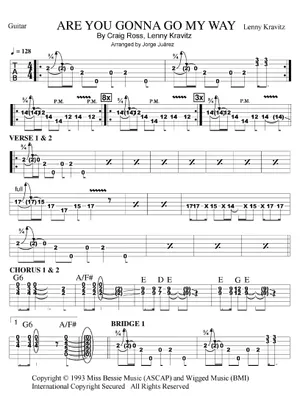
For guitarists in the United States, “Are You Gonna Go My Way” by Lenny Kravitz is a great rock song to learn by ear and with licensed guitar tab. The song uses a bright, driving rock sound, strong power-chord shapes, and a tight main riff. You can usually learn the part in standard tuning without a capo.
This guide explains how to find a legal tab, understand the song’s guitar parts, build the right tone, and fix common playing problems. It does not reproduce the full copyrighted tab or lyrics.

Quick answer: Where can you find the “Are You Gonna Go My Way” guitar tab?
You can find licensed or authorized versions through music retailers and tab services such as:
- Hal Leonard
- Musicnotes
- Sheet Music Direct
- Licensed digital tab platforms
- Official songbooks that include Lenny Kravitz guitar parts
Search for:
Lenny Kravitz Are You Gonna Go My Way guitar tab
Check the product details before buying. Some versions include standard notation and tab, while others contain only chord charts or simplified arrangements.
The original recording is commonly played in standard tuning: E–A–D–G–B–E. The main guitar part centers on powerful low-string shapes and a repeated rock riff. Start slowly, then increase speed once your fretting hand and picking hand move together.

What you need before learning the song
You need a guitar, an amp or practice setup, and a reliable reference recording. A tuner is also useful, even if your guitar is already close to standard tuning.
Basic setup
Use this starting setup:
| Item | Starting point |
|---|---|
| Tuning | Standard tuning, E–A–D–G–B–E |
| Capo | None for the common arrangement |
| Guitar | Electric guitar preferred, but acoustic guitar can work |
| Pick | Medium or medium-heavy pick |
| Sound | Moderate gain with clear attack |
| Practice speed | Begin well below the recording speed |
The song depends more on rhythm and attack than on complex effects. A clean guitar can help you learn the notes. Add overdrive after the part feels steady.
Learn the main symbols in guitar tab
Most guitar tabs use six lines. The bottom line represents the low E string, and the top line represents the high E string.
Common symbols include:
- 0 — play an open string
- 3, 5, or another number — fret that position
- x — mute the string
- h — hammer-on
- p — pull-off
- / — slide up
- \ — slide down
- PM — palm mute
- ~ — vibrato or sustained movement, depending on the tab source
Read the rhythm carefully. A tab may show the correct fret numbers but give little help with timing. Listen to the recording while you read.

How to learn the main guitar riff
The best method is to learn the riff in small rhythm blocks instead of trying to play the entire song at once.
1. Tune and check the open strings
Tune from the lowest string to the highest:
- Low E
- A
- D
- G
- B
- High E
Play a few open strings after tuning. If the guitar sounds sharp or flat when you press a fret, check your finger pressure and intonation.
2. Start with the low-string movement
The main riff uses a strong low-string sound. Many players approach it with power-chord shapes or single notes on the low E and A strings.
Do not rush to add every detail. First, learn the movement between the main notes. Play each group slowly and make every note sound clear.
A useful practice pattern is:
- Play one short phrase.
- Stop.
- Repeat it five times.
- Add the next phrase.
- Join both phrases together.
This method helps your hands remember the shape without turning the whole song into one long guess.
3. Use firm, controlled picking
Use downstrokes first if they help you lock into the beat. Once the rhythm feels easy, test alternate picking where the tab or your playing style requires it.
Keep the pick close to the strings. Large arm movements make fast rock riffs harder to control.
Your goal is not to hit the strings as hard as possible. Your goal is to make each stroke land at the same time and with the same force.
4. Add the power-chord weight
After you can play the single-note framework, add the fuller chord shapes from your licensed tab. Power chords usually contain a root note and a fifth. They sound strong without adding the major or minor third that defines a full chord.
For example, an E5 power chord contains:
- E as the root
- B as the fifth
Keep unused strings muted. This prevents extra notes from making the riff sound loose.
5. Practice with a slow metronome
Set a metronome to a slow speed. Choose a pace at which you can play the part three times in a row without stopping.
Then raise the speed in small steps. If the riff becomes tense or uneven, lower the tempo again.
A simple practice plan looks like this:
| Stage | Goal |
|---|---|
| Slow practice | Correct notes and clean muting |
| Medium practice | Smooth changes and steady timing |
| Near-recording speed | Strong attack without tension |
| Full-speed practice | Match the song’s feel and accents |
The sign of progress is not only speed. A good take should also have clear notes, even rhythm, and controlled noise.
How to get the right guitar tone
The original guitar sound is aggressive but still clear. Too much gain can hide timing mistakes and make the riff sound muddy.
Start with these amp settings
Use these as a starting point rather than a fixed recipe:
- Gain: medium
- Bass: moderate
- Middle: medium to slightly high
- Treble: moderate
- Reverb: low
- Noise gate: light, if needed
Raise the gain only after the notes are clean. If the sound becomes thick and unclear, lower the gain and raise the guitar volume instead.
Use the bridge pickup
The bridge pickup usually gives the sharper attack needed for the main riff. If it sounds too thin, add a little middle or bass at the amp.
If your guitar has humbuckers, the sound may be naturally thicker. With single-coil pickups, you may need a little more gain or mids.
Control unwanted noise
Rock riffs can create extra string noise. Use:
- The side of your picking hand to mute lower strings
- Your fretting hand to lightly touch strings you are not playing
- Short, clean releases when the tab shows stops
- Less gain while learning
Good muting makes the riff sound tighter than simply adding more distortion.

Chords and song structure
A simplified arrangement often uses power-chord movement built around the song’s central rock riff. The exact chord names and voicings can vary between full, simplified, acoustic, and live arrangements.
A common learning approach is:
- Learn the intro riff.
- Practice the main verse rhythm.
- Add the chorus power-chord movement.
- Learn the transition into the next section.
- Add the solo or lead fills last.
Do not assume that every tab uses the same arrangement. One version may show the studio guitar part, while another may simplify the song for beginners.
Why chord-only versions can sound different
A chord chart may show broad harmony but leave out:
- Muted hits
- Slides
- Short rests
- Double-stops
- Pick direction
- Riff accents
- Guitar overdubs
If you play only the listed chords, the song may have the right harmony but not the same energy. Use a full tab or notation-and-tab version when you want to copy the recorded guitar part more closely.

Common problems and how to fix them
The riff sounds muddy
Likely causes:
- Too much distortion
- Unmuted strings
- Fretting too hard
- Low-quality or poorly adjusted setup
Fix: Lower the gain, play more slowly, and check each note separately. Let the amp create some sustain instead of forcing it with excessive distortion.
The timing feels uneven
Likely causes:
- Picking hand moves faster than the fretting hand
- Pauses are being ignored
- You are learning without a steady beat
Fix: Practice with a metronome. Count the beat aloud if needed. Short rests are part of the riff, not empty space.
Chord changes stop the groove
Likely causes:
- You lift every finger between shapes
- Your thumb is squeezing the neck
- You are using shapes that are too large
Fix: Use compact power-chord shapes. Keep your thumb relaxed and move only the fingers that must move.
The song sounds too slow
Likely causes:
- The metronome is set for practice rather than performance
- The recording has a strong forward feel
- Notes are being held too long
Fix: Keep the practice speed slow, but copy the song’s short note lengths and accents. Speed is only one part of the feel.
The tab does not match the recording
This can happen because of:
- A simplified arrangement
- Different live and studio parts
- Alternate tuning
- A transcription error
- Different versions of the song
Compare the tab with the recording. If the tab says one thing but the audio clearly suggests another, check a second licensed source rather than assuming your guitar is wrong.

How to practice the full song
Use a section-by-section plan.
Day 1: Main riff
Learn the opening phrase at a slow speed. Focus on clean notes and muting.
Day 2: Verse rhythm
Add the verse part. Practice the change from the riff into the verse without stopping.
Day 3: Chorus
Learn the larger chord movement. Keep the strumming hand moving even during rests.
Day 4: Transitions
Practice the points where the song changes sections. These often cause more trouble than the riffs themselves.
Day 5: Full run
Play along with the recording at a reduced speed if possible. Mark every place where you lose time.
Day 6: Tone and dynamics
Adjust your amp and practice playing softer and louder. The riff should have shape, not one constant volume.
Day 7: Performance take
Record yourself. Listen for timing, string noise, weak chord changes, and missed stops.
Recording is useful because the guitar can feel correct while still sounding late or uneven in playback.

Is it legal to download a guitar tab?
Copyright rules vary by country and by the way a tab is created or shared. In the United States, a song’s composition and its recorded performance are separate copyrighted works. A guitar transcription can involve the underlying musical composition, while a recording also includes the specific recorded performance.
The safest option is to use a tab sold or distributed by a licensed publisher or authorized service. Avoid sites that clearly share scans, copied books, or full transcriptions without permission.
You can still use short educational examples, chord concepts, and technique advice without reproducing the complete tab. For the exact notes and rhythm, use a lawful source.
What to check before buying
Look for:
- The artist and exact song title
- Standard notation plus tab, if needed
- The correct version or album
- A difficulty level that matches your skill
- Whether printing or offline access is allowed
- Whether the arrangement is full or simplified
- Whether the purchase includes guitar notation or only chords
Availability and formats can change, so check the current product page before paying.

Key takeaways
- “Are You Gonna Go My Way” is commonly learned in standard tuning.
- The main guitar sound comes from tight rhythm, power-chord weight, and controlled gain.
- Learn the riff in short sections before adding the full arrangement.
- Use a metronome and increase speed in small steps.
- A chord chart may not include the recording’s detailed riffs and accents.
- For the complete notes, use a licensed tab or official songbook.
- Clean muting and steady timing matter more than heavy distortion.
FAQs
What tuning is used for “Are You Gonna Go My Way”?
The common guitar arrangement uses standard tuning: E–A–D–G–B–E. Some user-created tabs may use a different tuning, so check the tuning line at the top of the tab before you begin.
Is the song suitable for beginner guitarists?
A beginner can learn the main riff with slow practice, but the full performance may be challenging. The difficult parts are timing, muting, quick movement, and maintaining a strong rock feel.
Do I need an electric guitar?
No. You can learn the notes on an acoustic guitar. An electric guitar makes it easier to reproduce the song’s gain, sustain, and attack.
What should I do if the tab uses different notes from another version?
First, check whether the two tabs use different arrangements. One may simplify the riff, while another may transcribe the studio or live guitar part. Compare both versions with the recording and confirm the tuning.
How can I play the song without a full tab?
Use a licensed chord chart, listen for the main riff, and build the song section by section. Start with the bass-note movement and rhythm. Then add power chords, muted hits, and fills as your ear improves.
Final advice
The best way to learn “Are You Gonna Go My Way” guitar tab is to combine a licensed transcription with careful listening. Start with the main riff, keep the gain moderate, and practice the rhythm before chasing speed. Once the part feels steady, add the song’s accents and tone details.
Your next step is simple: tune to standard tuning, choose a legal tab source, and practice the opening riff at a slow tempo until you can play it cleanly three times in a row.

Senior Music Reviewer
Alex Carter is a seasoned music reviewer with over a decade of experience in the world of sound and instruments. Passionate about helping musicians and enthusiasts make informed choices, he brings sharp insights and in-depth knowledge to every review. From classical instruments to modern gear, Alex combines technical expertise with a love for music to deliver content that resonates with readers.
As a Senior Music Reviewer and expert author on Tuneluma.com, Alex is dedicated to sharing honest evaluations, practical advice, and thoughtful commentary to guide readers in their musical journey.