The electric guitar was invented in the United States, with the key breakthrough taking place in Los Angeles, California, in the early 1930s. Inventor George Beauchamp designed an electromagnetic pickup, while Adolph Rickenbacker helped build and manufacture the instrument. Their work led to the Rickenbacker “Frying Pan,” widely regarded as the first commercially produced electric guitar.
The story is more complex than one person or one date. Several US inventors tested ways to amplify guitar sound during the 1920s. However, Los Angeles became the center of the first successful electric-guitar design and production.

The Short Answer: Los Angeles, California
The modern electric guitar began in Los Angeles, California, around 1931 and 1932.
George Beauchamp developed the basic electromagnetic pickup. This pickup used magnets and a coil of wire to detect the movement of metal guitar strings. It then changed that movement into an electrical signal.
Adolph Rickenbacker helped Beauchamp turn the idea into a working instrument. Rickenbacker had metalworking skills and owned a company that could produce the guitar body and hardware.
The result was a small, steel-bodied, lap-style guitar. Its long neck and round body gave it the nickname “Frying Pan.” The instrument had to connect to an external amplifier. Without an amplifier, its sound was weak.
The first models were made by the Ro-Pat-In Corporation, later known as Rickenbacker. They were produced in Los Angeles and sold in the early 1930s.
Key facts
| Question | Answer |
|---|---|
| Where was the electric guitar invented? | Los Angeles, California, United States |
| Who developed the first successful design? | George Beauchamp, with help from Adolph Rickenbacker |
| What was the first famous model? | Rickenbacker “Frying Pan” |
| When did development occur? | Mainly from 1931 to 1932 |
| When was the pickup patent filed? | 1932 |
| When was the patent granted? | 1937 |
| Was it a solid-body guitar? | Yes, the early Rickenbacker model used a solid metal body |
The best answer is therefore Los Angeles, not one exact building or date. The instrument grew from several experiments, but Beauchamp and Rickenbacker created the first widely recognized commercial electric guitar.
Why Guitarists Needed Electricity
Guitarists needed amplification because traditional guitars could not compete with louder instruments.
In the 1920s, dance bands and jazz groups often used brass, drums, piano, and several horns. A regular acoustic guitar could become hard to hear. A musician could play more forcefully, but that did not solve the problem. Playing harder often changed the tone without producing enough volume.
Electric amplification offered a new answer. Instead of making the guitar body much larger, engineers could capture the string vibration and send it to an amplifier.
The key device was the pickup. A pickup is an electromagnetic or piezoelectric sensor that turns string movement into an electrical signal. The amplifier then increases that signal and sends it to a loudspeaker.
This process created new design problems:
- The pickup had to detect the strings clearly.
- The guitar had to work with an amplifier.
- The instrument had to resist unwanted feedback.
- The body had to support the neck and hardware.
- The sound had to remain useful for live performance.
The early electric guitar solved the volume problem, but it did not immediately produce the clean, flexible sound associated with modern rock music. That sound developed over many later decades.

Who Invented the First Electric Guitar?
George Beauchamp is usually credited with inventing the first successful electric guitar pickup and helping create the first commercial electric guitar.
Beauchamp was an American inventor and musician. Before working on the electric guitar, he was involved with the development of stringed instruments and electric amplification.
His most important contribution was the electromagnetic pickup. The design used a horseshoe-shaped magnet around a coil. When a steel string vibrated near the magnet, it changed the magnetic field. The coil converted that change into an electrical signal.
Adolph Rickenbacker played a different but equally important role. He helped manufacture the instrument and gave Beauchamp access to metalworking resources. The two men worked in Los Angeles, where the first instruments were built.
The work also involved other people and companies. Beauchamp had connections with the National String Instrument Corporation, which made resonator guitars. Rickenbacker later became central to the commercial production of electric instruments.
It is more accurate to describe the invention as a team effort:
- George Beauchamp: Developed the important electromagnetic pickup.
- Adolph Rickenbacker: Helped build and produce the instrument.
- Ro-Pat-In Corporation: Manufactured and sold early electric guitars.
- National and other instrument makers: Contributed to the wider development of amplified string instruments.
This shared history explains why different sources may name different inventors.
What Was the First Electric Guitar?
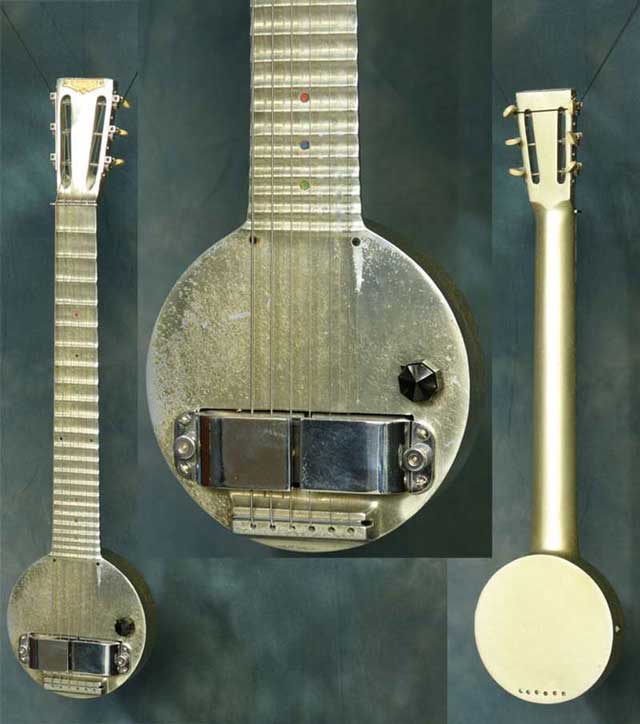
The Rickenbacker Electro A-25, often called the Frying Pan, is commonly identified as the first commercially produced electric guitar.
It was a lap steel guitar. The player placed the instrument across the legs and used a metal bar to change the pitch. Unlike a normal acoustic guitar, the instrument had a solid aluminum body and depended on an amplifier for strong volume.
The guitar looked unusual because it had:
- A circular metal body
- A long, narrow neck
- A horseshoe-shaped pickup
- No large acoustic sound chamber
- A design made for lap-style playing
The first Frying Pan guitars appeared around 1932. Some early examples had features that varied by production period, so descriptions can differ between museum records and instrument historians.
The design mattered for two reasons. First, it worked. Second, it showed that an electric guitar did not need a large hollow body to create a useful musical sound.
The Frying Pan was not yet the standard guitar shape used today. It was closer to a Hawaiian steel guitar. Still, its pickup system established the basic electric-guitar principle used by later instruments.
A Simple Timeline of Electric Guitar History
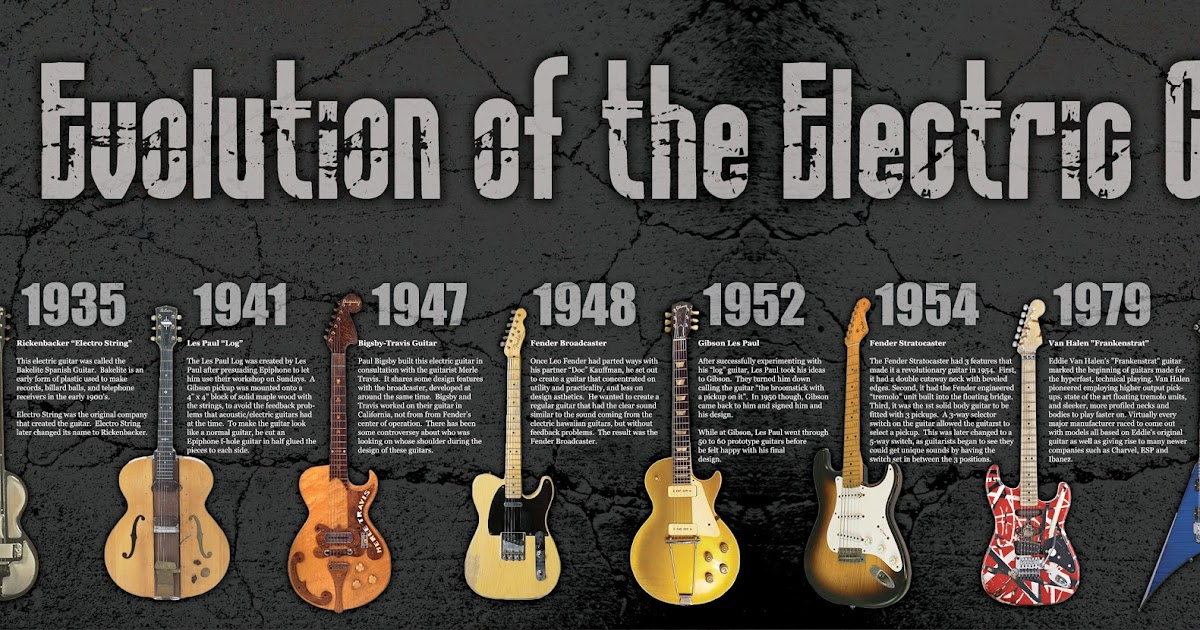
The electric guitar did not appear fully formed. Its history moved through several important stages.
| Year or period | Development | Why it mattered |
|---|---|---|
| 1920s | Musicians and inventors test amplification methods | Acoustic guitars were too quiet for large bands |
| Early 1930s | George Beauchamp develops an electromagnetic pickup | String vibration can become an electrical signal |
| 1931–1932 | Beauchamp and Rickenbacker build early electric guitars | The design becomes a practical instrument |
| 1932 | Ro-Pat-In begins commercial production | Players can buy an electric guitar |
| 1936 | Gibson releases the ES-150 | Electric Spanish guitar reaches a wider market |
| Late 1930s | Charlie Christian uses the ES-150 with big bands | The electric guitar gains a major solo role |
| 1940s–1950s | Solid-body designs improve | Feedback becomes easier to control |
| 1950s onward | Fender, Gibson, Gretsch, and others expand the market | Electric guitar becomes central to popular music |
The Gibson ES-150, introduced in 1936, was another major step. It was an electric Spanish guitar, meaning the player held it in the standard guitar position rather than across the lap.
Gibson’s instrument became especially famous because jazz guitarist Charlie Christian used it with the Benny Goodman Sextet and Orchestra. His playing showed that an amplified guitar could act as a lead instrument, not just a rhythm instrument.
Was the Electric Guitar Invented in the United States or Canada?
The first successful commercial electric guitar was invented and produced in the United States.
The key work took place in Los Angeles, California. That work formed the basis for the Rickenbacker Electro A-25.
Other countries later made major contributions to guitar design, music, and manufacturing. Canadian, British, Japanese, German, and other builders helped shape the electric guitar industry. But those later contributions do not change the location of the first commercial breakthrough.
Some confusion comes from the history of amplified string instruments. Inventors in different countries worked on microphones, pickups, resonator systems, and electronic amplification. These earlier ideas helped create the conditions for the electric guitar.
The narrow question has a clear answer:
The first commercially successful electric guitar was developed in Los Angeles, California, in the United States.
What Came Before the Rickenbacker Frying Pan?
The Frying Pan was not created from nothing. Earlier inventions helped solve parts of the same problem.
In the 1920s, musicians and instrument makers explored several ways to make guitars louder. Some used microphones placed near the guitar. Others experimented with contact pickups or electrical devices attached to the instrument.
These early systems had limits. A microphone could pick up unwanted sound from the room. It could also produce feedback when the volume increased. A pickup mounted near the strings offered better control, but the technology was still developing.
Resonator guitars were another important step. Companies such as National and Dobro used metal cones to make guitars louder without electricity. These guitars were acoustic, not electric, but they showed how instrument makers were responding to the same volume problem.
The difference is important:
- A resonator guitar uses a metal cone to increase acoustic volume.
- An acoustic-electric guitar has a pickup but usually keeps an acoustic body.
- A solid-body electric guitar uses a pickup and does not rely on a hollow body for its main sound.
- An electric guitar is a broad term that includes several body types.
The Rickenbacker Frying Pan used electricity to create its amplified sound. That is why it holds such an important place in electric-guitar history.
How the First Electric Guitar Pickup Worked
The early Rickenbacker pickup used the basic principles of electromagnetism.
A magnet created a magnetic field around the strings. The strings needed to contain magnetic metal, such as steel. When a string moved, it changed the magnetic field near the pickup.
A coil of wire detected that change. The pickup produced a small electrical signal that represented the string’s vibration. The signal then traveled through a cable to an amplifier.
The process can be shown simply:
- The player plucks a metal string.
- The string vibrates near the magnet.
- The magnetic field changes.
- The coil creates a small electrical signal.
- The amplifier increases the signal.
- The speaker turns the signal back into sound.
This design created much more volume than a normal guitar could produce by itself. It also allowed musicians to shape the sound with amplifiers, tone controls, and later effects.
The pickup did not “record” the whole sound of the guitar body. It mainly detected the movement of the strings. That is one reason electric guitars can have solid, hollow, or semi-hollow bodies and still work with magnetic pickups.
When Did the Electric Guitar Become Popular?
The electric guitar began gaining wider attention in the 1930s, especially through jazz and Hawaiian music.
Hawaiian steel guitar players were early users because the instrument fit their playing style. The guitar could sit across the player’s lap, and the amplified sound helped it stand out in bands.
Jazz guitarists soon adopted electric instruments as well. The Gibson ES-150 became especially influential after Charlie Christian used it for melodic lines and solos.
The electric guitar became even more popular after World War II. New designs made the instruments easier to manufacture and play. Amplifiers also improved, and musicians began using distortion, tremolo, reverb, and other effects.
The 1950s brought a major shift. Fender developed solid-body electric guitars such as the Telecaster and Stratocaster. Gibson introduced the Les Paul model in 1952. These instruments helped define blues, country, rock and roll, and later rock music.
The modern electric guitar is therefore the result of several stages:
- Early amplification experiments
- The electromagnetic pickup
- The first commercial lap steel guitars
- Electric Spanish guitars
- Solid-body designs
- Modern amplifiers and effects
Common Misconceptions About the Electric Guitar’s Invention
“The electric guitar was invented by one person.”
George Beauchamp is often named as the inventor, but the first commercial instrument depended on cooperation with Adolph Rickenbacker and manufacturing companies.
“The Fender Telecaster was the first electric guitar.”
The Telecaster was one of the first successful mass-produced solid-body electric guitars. It appeared in the early 1950s, about two decades after the Frying Pan.
“The first electric guitar was made by Gibson.”
Gibson made the important ES-150 in 1936. However, the Rickenbacker Frying Pan came earlier.
“The first electric guitar looked like a modern guitar.”
The first commercial model was a lap steel guitar with a metal body and an unusual circular shape. The familiar guitar shape became more common later.
“The electric guitar was invented to create rock music.”
Rock music did not yet exist when the first electric guitars appeared. The original need came mainly from jazz, Hawaiian music, and dance-band performance.
Sources Used for the History
The main historical details in this article are supported by records and collections from recognized music-history institutions and patent archives, including:
- United States Patent and Trademark Office, George Beauchamp’s electromagnetic pickup patent, US Patent No. 2,089,171
Google Patents record - National Music Museum, records on early electric and amplified string instruments
National Music Museum - Smithsonian Institution, collections and articles on American musical instruments
Smithsonian Institution - The Metropolitan Museum of Art, historical electric and amplified instruments
The Met - Rickenbacker historical records, early Electro and “Frying Pan” instruments
Rickenbacker
These sources support the broad conclusion that Los Angeles was the main location of the first successful commercial electric-guitar development. Dates and model descriptions can vary slightly because early instruments changed during production.

Frequently Asked Questions
Where exactly in Los Angeles was the electric guitar invented?
The early development took place through the work of George Beauchamp and Adolph Rickenbacker in the Los Angeles area. Sources often identify Los Angeles as the city, but they do not always name one single workshop as the only birthplace of the instrument.
What was the first electric guitar called?
The first famous commercial model was the Rickenbacker Electro A-25, commonly called the Frying Pan because of its round body and long neck.
Was the first electric guitar hollow-body or solid-body?
The Frying Pan had a solid metal body. Later electric guitars included hollow-body, semi-hollow, and solid-wood designs.
When did Gibson make its first electric guitar?
Gibson introduced the ES-150 in 1936. It became one of the first important electric Spanish guitars and was strongly linked with jazz guitarist Charlie Christian.
Did Leo Fender invent the electric guitar?
No. Leo Fender helped develop some of the most influential solid-body electric guitars, including the Telecaster and Stratocaster. His major work came about two decades after the first commercial electric guitars.
Conclusion: The Electric Guitar Began in Los Angeles
The electric guitar was invented in the United States, with its first successful commercial form developed in Los Angeles, California.
George Beauchamp created the key electromagnetic pickup, and Adolph Rickenbacker helped turn the design into a working product. Their Rickenbacker “Frying Pan,” released in the early 1930s, became the foundation for later electric guitars.
The instrument then evolved through Gibson’s ES-150, Charlie Christian’s jazz playing, Fender’s solid-body designs, and the growth of rock music. So, while no single person invented every part of the modern electric guitar, Los Angeles is the clearest answer to where the electric guitar was invented.

Senior Music Reviewer
Alex Carter is a seasoned music reviewer with over a decade of experience in the world of sound and instruments. Passionate about helping musicians and enthusiasts make informed choices, he brings sharp insights and in-depth knowledge to every review. From classical instruments to modern gear, Alex combines technical expertise with a love for music to deliver content that resonates with readers.
As a Senior Music Reviewer and expert author on Tuneluma.com, Alex is dedicated to sharing honest evaluations, practical advice, and thoughtful commentary to guide readers in their musical journey.