For guitarists in the United States, intonation is the guitar’s ability to play in tune across the fretboard. A guitar with good intonation sounds correct when you play open strings, chords, and notes higher up the neck. A guitar with poor intonation may sound in tune at the first fret but sharp or flat near the 12th fret.
Intonation is adjusted by changing the length of each string. On most electric guitars, you do this with the small saddles on the bridge. On acoustic guitars, intonation usually depends on the fixed bridge, saddle shape, neck setup, strings, and the work of a qualified guitar technician.

Guitar intonation, explained simply
Guitar intonation is the relationship between the guitar’s open-string tuning and the pitch of fretted notes.
When intonation is correct:
- The open string is in tune.
- The 12th-fret harmonic matches the note at the 12th fret.
- Chords sound more even across the neck.
- Notes stay close to their correct pitch as you play higher.
- Recording, playing with other musicians, and using a tuner become easier.
When intonation is poor, some notes may sound sharp or flat even though the open strings are tuned correctly.
The problem becomes easy to hear at the 12th fret. The 12th fret should produce the same note name as the open string, one octave higher. For example:
- Open low E string: E
- 12th-fret note: E, one octave higher
- Open A string: A
- 12th-fret note: A, one octave higher
This does not mean every note will have perfect pitch in every playing situation. fretting pressure, string condition, action, tuning system, and the guitar’s design all affect pitch. Good intonation means the guitar is adjusted so these differences stay as small as practical.
Why the 12th fret matters
The 12th fret marks the halfway point of the vibrating string’s scale length. The harmonic above the 12th fret divides the string in half and produces an octave above the open note.
The fretted 12th-fret note is different. Pressing the string down to the fret stretches it slightly. That stretch can raise the pitch. The bridge saddle must sit a little farther back to compensate for this effect.
This is why the saddles on a guitar bridge are often arranged at different distances. The thicker strings usually need more compensation than the thinner strings.

Why does guitar intonation go out of tune?
Guitar intonation can change because of setup, string condition, playing force, temperature, and instrument design. The most common causes are old strings, incorrect action, excessive neck relief, and a bridge saddle that needs adjustment.
Old or damaged strings
Strings lose their consistent shape as they age. They can collect dirt, develop flat spots, or become twisted. A damaged string may not vibrate evenly along its length.
Before checking intonation, install a fresh set of strings of the gauge you plan to use. There is little value in adjusting a guitar around strings that you will soon replace.
String gauge changes
String gauge means the thickness of a string. A heavier or lighter set changes string tension and can affect:
- Neck relief
- Action
- Fretting feel
- Pitch when a note is fretted
- The amount of saddle compensation needed
If you change from .010–.046 strings to .011–.049 strings, for example, the guitar may need a new setup. The exact effect depends on the guitar, tuning, scale length, bridge, and playing style.
High action
Action is the distance between the strings and the frets. High action makes you push the string farther down to reach the fret. That extra movement stretches the string and can make fretted notes sound sharp.
If the note at the 12th fret is sharp, moving the saddle backward may help. However, an unusually high action may point to a larger setup issue. Adjusting the saddle alone may not fully solve it.
Neck relief
Neck relief is the small amount of forward curve in the neck that allows the strings to vibrate without buzzing.
Too much relief can raise the action, especially around the middle of the neck. Too little relief can cause fret buzz. Both conditions can affect how hard you press the strings and how accurately the notes play.
Fretting pressure
Pressing too hard can make notes sound sharp. This is common with new players and with light-gauge strings. The note may appear out of tune even when the guitar’s mechanical intonation is reasonable.
Use only enough pressure to make the note ring clearly. Compare your fretted note with a tuner while using a light, normal touch.
Temperature and humidity
Temperature changes affect string tension and the materials in the instrument. Humidity changes can also affect the neck, top, bridge, and action, especially on acoustic guitars.
Let a guitar reach room temperature before making detailed setup decisions. Keep acoustic guitars in a stable indoor environment. In the United States, very dry winter air can be a particular concern in heated homes.

How to check guitar intonation
You can check intonation with a reliable electronic tuner. A chromatic tuner is useful because it shows whether the note is sharp or flat.
What you need
- A guitar with reasonably fresh strings
- A chromatic tuner
- A small screwdriver for an electric guitar bridge, if needed
- The guitar’s normal tuning
- A stable playing position
- A quiet room
Tune the guitar carefully before testing. Check each string more than once because tuning one string can slightly change the neck or bridge balance.
The basic test
- Tune the open string accurately.
- Play the 12th-fret harmonic without pressing the string to the fret.
- Check the pitch.
- Play the fretted note at the 12th fret with normal pressure.
- Compare the fretted note with the harmonic.
- Repeat the test for every string.
The harmonic and fretted note should show the same note name and nearly the same pitch.
How to read the result
| 12th-fret fretted note | Meaning | Usual saddle adjustment |
|---|---|---|
| Sharp compared with the harmonic | The vibrating string length is effectively too short | Move the saddle away from the neck |
| Flat compared with the harmonic | The vibrating string length is effectively too long | Move the saddle toward the neck |
| Nearly the same pitch | Intonation is close | No major adjustment needed |
Use very small adjustments. A quarter turn or a few millimeters can make a noticeable difference, depending on the bridge design.
After each adjustment:
- Retune the open string.
- Check the harmonic again.
- Check the fretted 12th-fret note.
- Repeat until the difference is small.
The order matters because moving the saddle changes string tension and can change the open-string tuning.

How to adjust intonation on an electric guitar
Most electric guitars use adjustable bridge saddles. Each saddle supports one string and can move forward or backward with a screw.
The exact bridge design varies. Read the manufacturer’s instructions before removing parts or turning unfamiliar screws.
Step-by-step electric guitar adjustment
-
Install the correct strings.
Use the gauge and tuning you plan to keep. -
Tune the guitar.
Tune each open string to your normal tuning. -
Check neck relief and action first.
If the action is unusually high or the neck has a visible problem, correct the basic setup before fine-tuning intonation. -
Compare the 12th-fret harmonic and fretted note.
Use normal fretting pressure. -
Move the saddle.
If the fretted note is sharp, move the saddle toward the tailpiece. If it is flat, move the saddle toward the neck. -
Retune and test again.
Always retune after moving a saddle. -
Check the guitar in other areas.
Play open chords, notes around the fifth fret, and notes above the 12th fret. -
Repeat for each string.
Do not force a saddle screw. If the screw is tight, stripped, rusty, or moving the saddle in an unexpected direction, stop. A damaged bridge can cost more to repair than a professional setup.
What success sounds like
A well-adjusted electric guitar should not make every note perfectly equal in pitch under every playing condition. Instead, it should produce a useful balance across the neck.
You should hear:
- Chords that sound less sour higher up the neck
- Notes that agree more closely with a tuner
- Better results when playing with a piano, keyboard, or another guitar
- Less need to retune while moving around the fretboard

Can you adjust intonation on an acoustic guitar?
Most acoustic guitars do not have individually adjustable bridge saddles. Their saddle is usually a single piece of bone, synthetic material, or another hard material.
That means acoustic guitar intonation is normally set by the saddle’s compensated shape and its position in the bridge. Small changes may be possible, but they require careful shaping or replacement of the saddle.
Common acoustic guitar solutions
A guitar technician may:
- Check neck relief and action
- Confirm the bridge is secure
- Inspect the saddle height and shape
- Fit a compensated saddle
- Reshape or replace the saddle
- Check fret placement and neck geometry
- Confirm that the guitar is suitable for the chosen string gauge
Do not sand the saddle without measuring its height and keeping a record of the original shape. Removing too much material can create low action, fret buzz, weak volume, or a difficult repair.
Some acoustic guitars have adjustable systems, such as bridge designs with separate saddle sections. These are less common than the fixed-saddle design.
When an acoustic guitar needs professional help
Seek help from a qualified guitar technician if:
- The 12th-fret note is far out of tune
- The action is very high
- The bridge is lifting
- The top is swelling or sinking
- The neck looks twisted
- The truss rod needs adjustment
- The guitar has a suspected fret or construction problem
A saddle adjustment cannot correct every intonation problem. If the neck angle or fret placement is wrong, more extensive work may be needed.
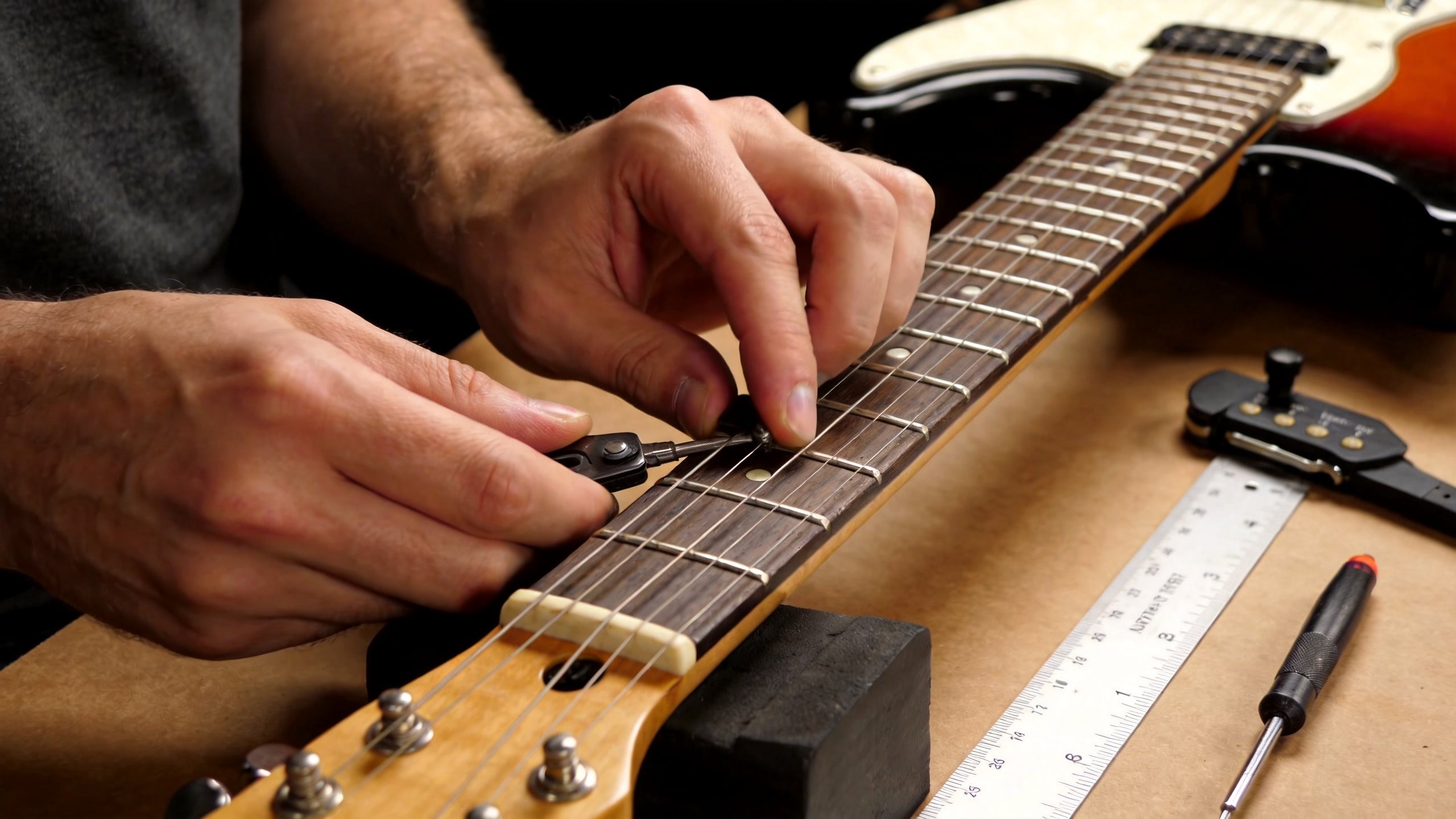
Intonation versus tuning: what is the difference?
Tuning sets the pitch of the open strings. Intonation helps the fretted notes stay accurate relative to those open strings.
For example, a guitar may tune perfectly at the open strings but still sound sharp at the 12th fret. That is an intonation problem, not simply a tuning problem.
| Issue | What it affects | Typical action |
|---|---|---|
| Tuning | The pitch of open strings | Tune the machine heads |
| Intonation | Pitch accuracy across the fretboard | Adjust the bridge or setup |
| Neck relief | Neck curve and string clearance | Make a measured setup adjustment |
| Action | String height above the frets | Adjust the bridge, saddle, or neck |
| Fret condition | Contact points and note accuracy | Inspect or repair frets |
These systems interact. A guitar should be tuned before intonation is checked, and its basic neck and action setup should be reasonable.

What is compensated intonation?
Compensated intonation means the bridge or saddle is shaped so different strings receive different effective lengths.
A guitar string does not behave like a perfect, flexible line. When you press it to a fret, you stretch it. Thick strings, wound strings, and strings with different tension can require different compensation.
On many electric guitars, the saddles form a staggered pattern. On acoustic guitars, the saddle often slopes or has separate contact points for different strings.
Compensation helps the guitar play more accurately, but it cannot remove every pitch difference. Equal temperament, fret design, string tension, playing pressure, and the limits of the instrument all remain part of the result.
Why perfect intonation is not always possible
Most fretted guitars use an equal-tempered fret layout. This system divides the octave into mathematically equal steps so the guitar can play in many keys.
Equal temperament is a practical compromise. Some intervals are not as pure as they would be in other tuning systems. A guitar can be correctly set up and still produce small pitch differences between certain notes and chords.
This is normal. The goal is useful, consistent intonation rather than impossible perfection.

Common guitar intonation mistakes
Adjusting the saddle before changing old strings
Old strings can give false readings. Replace them first, stretch them gently, and tune the guitar several times.
Comparing the wrong notes
Compare the fretted 12th-fret note with the 12th-fret harmonic on the same string. Do not compare the 12th-fret note with an unrelated open string.
Pressing too hard
Use normal playing pressure. Excess force can make a note sharp and lead you to move the saddle too far.
Forgetting to retune
Retune the open string after every saddle movement. Otherwise, the next measurement may be misleading.
Making large adjustments
Move the saddle in small steps. Large changes make it easy to pass the correct position.
Ignoring the setup
Intonation is not separate from action and neck relief. If the action is extreme, saddle movement may only hide the real problem.
Using a damaged tuner or poor environment
A weak tuner signal, loud room, vibrating strings, or electrical noise can make readings unstable. Use a clear signal and confirm results by ear.

How often should you check guitar intonation?
Check intonation when you:
- Install a different string gauge
- Change the guitar’s tuning
- Adjust the action or neck relief
- Replace a bridge or saddle
- Notice that higher notes sound sharp or flat
- Prepare for recording or a major performance
- Move the guitar through a large temperature change
A guitar does not need constant intonation adjustment. If the strings, tuning, and setup remain stable, check it when a problem appears or during routine maintenance.
Drop tunings can change the feel and response of the strings. A guitar may need a different setup for frequent use in standard tuning, drop D, or lower tunings.

Frequently asked questions
Is guitar intonation the same as tuning?
No. Tuning sets the open strings. Intonation controls how accurately the fretted notes play across the neck.
How do I know if my guitar has bad intonation?
Tune the open string, then compare its 12th-fret harmonic with the fretted 12th-fret note. If the fretted note is consistently sharp or flat, the guitar may need an intonation adjustment or a broader setup.
Does changing strings affect intonation?
Yes. A different string gauge, brand, material, or tuning can change tension and fretting behavior. Check intonation after a major string change.
Can I fix acoustic guitar intonation myself?
You can inspect and measure it, but many acoustic guitars require saddle shaping or replacement. If you lack setup experience, a guitar technician is the safer choice.
Should the 12th-fret harmonic and fretted note be exactly identical?
They should be very close, but absolute perfection is not realistic on a fretted instrument. Aim for consistent, useful pitch across the neck.
Does intonation affect chords?
Yes. Poor intonation can make chords sound sour, especially higher on the neck. Correct intonation can make chords and single notes agree more closely with other instruments.
Key takeaways
- Guitar intonation is the guitar’s ability to play in tune across the fretboard.
- Check it by comparing the 12th-fret harmonic with the fretted 12th-fret note.
- A sharp fretted note usually requires the saddle to move away from the neck.
- A flat fretted note usually requires the saddle to move toward the neck.
- Use fresh strings and check the guitar’s action and neck relief first.
- Electric guitar saddles are usually adjustable; acoustic guitar saddles often need professional shaping.
- Small pitch differences are normal because fretted guitars use a practical equal-tempered system.
Final answer: what is intonation on a guitar?
Intonation is the adjustment that helps every note on a guitar stay close to its correct pitch, not just the open strings. It depends on string length, saddle position, action, neck relief, string gauge, fretting pressure, and the guitar’s design.
To check your guitar, tune an open string, compare the 12th-fret harmonic with the fretted 12th-fret note, and make only small bridge adjustments when needed. If the guitar has high action, neck problems, bridge damage, or a fixed acoustic saddle, have a qualified guitar technician inspect it before making major changes.

Senior Music Reviewer
Alex Carter is a seasoned music reviewer with over a decade of experience in the world of sound and instruments. Passionate about helping musicians and enthusiasts make informed choices, he brings sharp insights and in-depth knowledge to every review. From classical instruments to modern gear, Alex combines technical expertise with a love for music to deliver content that resonates with readers.
As a Senior Music Reviewer and expert author on Tuneluma.com, Alex is dedicated to sharing honest evaluations, practical advice, and thoughtful commentary to guide readers in their musical journey.