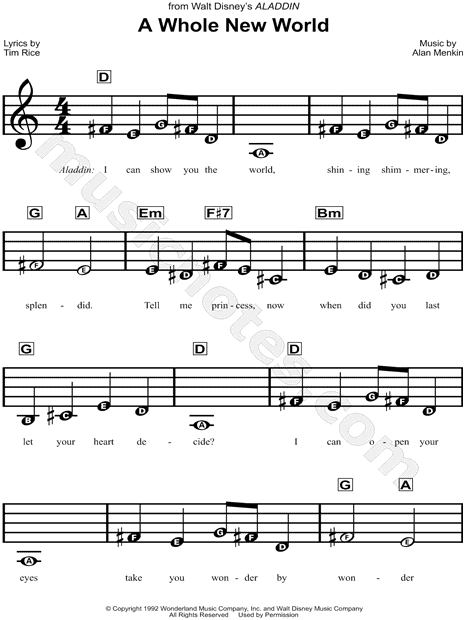
A Whole New World Piano Keys: Easy Tutorial
The easiest A Whole New World piano keys use C major, with simple white-key notes and beginner-friendly chords.
Learning the A Whole New World piano keys is a great way to build melody, chord, and rhythm skills at the same time. The song has a gentle, cinematic sound, yet many beginner arrangements reduce it to clear notes and familiar chords. This guide explains the key, notes, chords, rhythm, practice steps, and common mistakes so you can play it with confidence.

What Key Is A Whole New World In?
The original Disney song, written by Alan Menken with lyrics by Tim Rice, appears in different keys across sheet music, recordings, and piano tutorials. Many beginner versions place the song in C major because it uses only the white keys on the piano.
The A Whole New World piano keys may change when an arrangement is made for a singer. A professional pianist may also transpose the song to match a vocalist’s range. Therefore, always check the key signature before playing from sheet music.
For a beginner arrangement in C major:
• The main scale uses C, D, E, F, G, A, and B.
• There are no sharps or flats in the key signature.
• Middle C often serves as a useful starting point.
• The melody can be played with the right hand.
• The left hand can support the song with simple chords or bass notes.
C major is not always the original performance key. It is simply one of the easiest keys for learning the song. If you are singing, you may need to transpose the A Whole New World piano keys higher or lower.
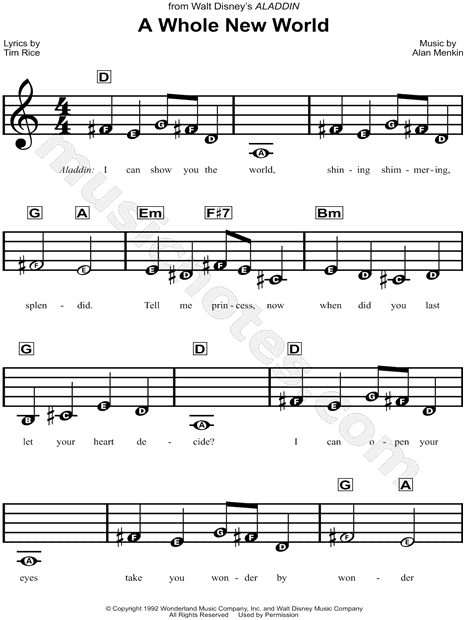
A Whole New World Piano Keys for Beginners
A piano key is one specific note on the keyboard. The white keys have letter names from A to G. The black keys create sharps and flats. In a C major arrangement, the melody mainly uses the white keys.
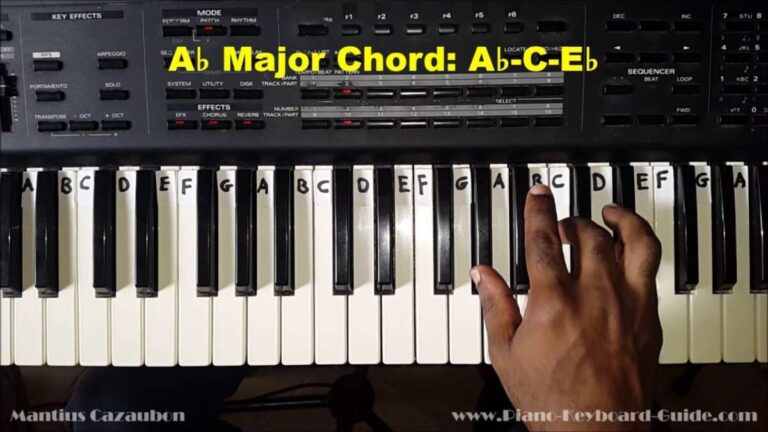
To find C, look for a group of two black keys. The white key directly to the left of that group is C. Middle C is near the center of most full-size keyboards.
When learning the A Whole New World piano keys, start by finding these notes:
• C: the white key before a group of two black keys
• D: the white key between the two black keys
• E: the white key after the two black keys
• F: the white key before a group of three black keys
• G: the white key between the first and second black keys in that group
• A: the white key between the second and third black keys
• B: the white key after the three black keys
The opening melody should feel smooth and connected. Do not rush from one note to the next. Let each note ring until the next note arrives, unless the arrangement shows a rest.
A useful first exercise is to play the C major scale slowly. Use your right-hand thumb on C, then place fingers two through five on D, E, F, and G. This helps you become familiar with the note area used by many simple A Whole New World piano keys arrangements.

Simple Chords for A Whole New World
Chords make the song sound full. A chord is a group of notes played together. In a beginner arrangement, the left hand may play one bass note while the right hand plays the melody.
Common chords used in simplified versions include:
• C major: C, E, and G
• G major: G, B, and D
• A minor: A, C, and E
• F major: F, A, and C
• D minor: D, F, and A
• E minor: E, G, and B
A simple practice pattern may use C, G, A minor, and F. This pattern appears in many popular songs, but it is not a complete transcription of every section of A Whole New World. The exact harmony depends on the arrangement.
Try playing each chord as a block. Then break it into separate notes. For example, play C major as C, E, and G together. After that, play C, then E, then G as a slow broken chord.
The left hand does not need to play large jumps at first. You can begin with one bass note per measure. Once that feels easy, add the full chord above or below the melody.

How to Play the Melody
The right hand usually carries the main tune. The melody rises and falls in a calm, flowing way, so relaxed movement matters more than speed.
Start with the melody alone. Use one hand and focus on these points:
• Read each note before playing it.
• Keep your wrist loose.
• Lift your fingers only as much as needed.
• Practice short phrases instead of the full song.
• Pause at natural musical breaks.
Do not try to play the complete song from memory on your first day. Divide it into small sections of two to four measures. Learn one section, repeat it several times, and then connect it to the next section.
A common mistake is using the same finger for every note. That can make the hand tense and cause missed notes. Follow the suggested fingering in your sheet music, but change it slightly if your hand feels strained.
When practicing the A Whole New World piano keys, imagine that the melody is a singer taking a breath. Each phrase should have a beginning, a gentle rise, and a soft ending. This approach creates a more musical performance than simply pressing the correct notes.
Reading Sheet Music for A Whole New World
Sheet music shows pitch, rhythm, timing, and expression. The treble clef usually contains the right-hand melody. The bass clef often contains the left-hand chords or bass notes.
The key signature tells you which notes are sharp or flat throughout the piece. If there are no sharps or flats, the arrangement may be in C major or A minor. The time signature explains how beats are grouped.
Many versions of the song use a steady meter, but the exact time signature can vary by arrangement. Count the beats aloud before adding the melody. For example, count “one, two, three, four” if the music is in common time.
Pay attention to these symbols:
• Quarter notes usually receive one beat in common time.
• Half notes usually receive two beats.
• Whole notes usually receive four beats.
• Rests show when not to play.
• Slurs connect notes into a smooth phrase.
• Ties extend a note across beats or measures.
If the rhythm feels difficult, clap it before playing. This simple step often solves problems faster than repeating the wrong notes. Rhythm is the road under the melody; without it, even correct A Whole New World piano keys can sound uncertain.
A Step-by-Step Practice Plan
A clear practice plan can make the song feel much easier. You do not need long sessions. Ten focused minutes can help more than an unfocused hour.
Step 1: Learn the key area
Find middle C and play the C major scale. Say each note name aloud. This builds a mental map of the keyboard.
Step 2: Practice the right hand
Play the melody slowly. Do not add chords until the notes and rhythm feel comfortable.
Step 3: Practice the left hand
Play the bass notes or chords by themselves. Move between them without stopping.
Step 4: Combine small sections
Join one melody phrase with its matching chord pattern. Repeat it at least five times without speeding up.
Step 5: Add expression
Play softly during calm phrases. Let important notes sing a little more. Use the sustain pedal with care.
Step 6: Increase the tempo
Use a metronome. Start at a slow speed, such as 50 to 60 beats per minute. Increase the tempo only when you can play the section three times without a major error.
One lesson many learners discover is that slow practice is not a punishment. It is a way to teach the hands where to go. Fast practice can hide mistakes, while slow practice gives the brain time to build a reliable path through the A Whole New World piano keys.
Using the Sustain Pedal
The sustain pedal can give the song a warm, orchestral sound. It allows notes to continue after you lift your fingers. However, too much pedal can make the music muddy.
Use the pedal when the harmony changes. Press it after you play a chord, then release and press it again when you move to the next chord. This keeps the sound connected without blending every chord together.
For beginners, these rules help:
• Change the pedal with each new chord.
• Keep the pedal off while learning difficult notes.
• Listen for blurred bass sounds.
• Use less pedal in fast passages.
• Practice without pedal before adding it.
The best pedal use is often subtle. The piano should sound smooth, not cloudy. If you cannot hear the individual A Whole New World piano keys, release the pedal and try again.
Common Mistakes to Avoid
Even simple piano arrangements can become difficult when technique gets in the way. Most problems come from rushing, poor fingering, or trying to play too much too soon.
Here are common mistakes and practical fixes:
• Playing too fast: Slow down until every note feels controlled.
• Ignoring rhythm: Count aloud or use a metronome.
• Using stiff fingers: Relax your shoulders, wrists, and hands.
• Adding chords too early: Learn the melody first.
• Pressing the pedal constantly: Change the pedal with the harmony.
• Skipping rests: Silence is part of the music.
• Practicing only from the beginning: Start from different sections to improve recall.
• Copying a tutorial without checking the key: Online videos may use a different arrangement or transpose the song.
If your version does not sound like another performance, that does not always mean you are playing incorrectly. The A Whole New World piano keys may differ because the player is using another key, octave, rhythm, or chord style.
How to Transpose the Song
Transposition means moving every note by the same distance. It lets you play the song in a key that suits your voice or skill level.
For example, if a C major arrangement feels too high for your singing voice, you might move it down to B major or A major. This changes the piano keys but keeps the relationship between the notes the same.
Digital keyboards often include a transpose button. This can be helpful for singing, but it may hide your understanding of the keyboard. If possible, learn the song in the written key first, then use the transpose feature for performance.
To transpose by hand:
-
Choose the new starting note.
-
Move every melody note by the same number of half steps.
-
Move every chord by the same distance.
-
Check the new key signature.
-
Play slowly and listen for wrong notes.
Transposition is useful, but it can become confusing if you mix two versions. Mark the key at the top of your sheet music so you know which A Whole New World piano keys you are practicing.
Beginner, Intermediate, and Advanced Arrangements
Not every piano version has the same difficulty. Choosing the right arrangement can save time and protect your confidence.
Beginner arrangement
A beginner version often has:
• A single-note melody
• Simple left-hand bass notes
• Basic chords
• A slower tempo
• Few large hand movements
This version is best for new players or anyone learning to read notes.
Intermediate arrangement
An intermediate version may include:
• Broken chords
• Moving bass lines
• More complex rhythms
• Octaves
• Melody notes placed inside chords
This style creates a fuller sound but requires better hand coordination.
Advanced arrangement
An advanced version may add:
• Rich chord extensions
• Wide left-hand jumps
• Fast fills
• Inner melodies
• Pedal changes
• Musical changes in tempo and volume
Choose a version that is slightly challenging, not overwhelming. The right arrangement should make you stretch while still allowing steady progress with the A Whole New World piano keys.
Frequently Asked Questions About A Whole New World Piano Keys
What are the easiest A Whole New World piano keys for beginners?
A C major arrangement is often the easiest because it uses the white keys and has no sharps or flats in the key signature. The exact notes still depend on the arrangement and octave.
Is A Whole New World in the key of C major?
Not always. The original recording and many published arrangements use different keys, while beginner tutorials often move the song to C major for easier playing.
Can I play A Whole New World with one hand?
Yes. You can play a simplified melody with the right hand alone. Adding left-hand bass notes or chords will make the song sound fuller.
What chords are used in A Whole New World?
Simplified versions may use chords such as C, G, A minor, F, D minor, and E minor. Professional arrangements can use more complex harmony and chord changes.
Do I need to read sheet music to learn the song?
No. You can learn from letter notes, chord charts, or a video lesson. Still, sheet music gives you more control over rhythm, fingering, dynamics, and the exact arrangement.
How long does it take to learn A Whole New World on piano?
A beginner may learn a simple section in a few practice sessions. Learning the full song with smooth rhythm and expression may take several weeks, depending on your experience and practice routine.
Conclusion
The A Whole New World piano keys become much easier when you start with the right key, learn the melody in small sections, and add chords slowly. C major is a helpful starting point, but different arrangements may use different keys, notes, and rhythms.
Practice with relaxed hands, a steady count, and careful pedal use. Focus on musical phrasing instead of simply playing every note. Once you can play a simple version, explore richer chords or transpose the song for your voice. Try a short section today, then share your progress or explore more beginner piano resources.

Senior Music Reviewer
Alex Carter is a seasoned music reviewer with over a decade of experience in the world of sound and instruments. Passionate about helping musicians and enthusiasts make informed choices, he brings sharp insights and in-depth knowledge to every review. From classical instruments to modern gear, Alex combines technical expertise with a love for music to deliver content that resonates with readers.
As a Senior Music Reviewer and expert author on Tuneluma.com, Alex is dedicated to sharing honest evaluations, practical advice, and thoughtful commentary to guide readers in their musical journey.