What Does P Mean In Guitar Tabs: Pull-Off Guide
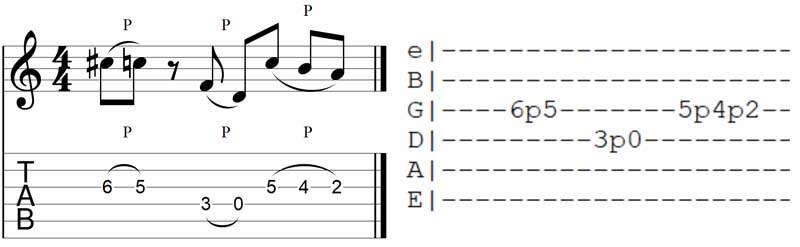
In guitar tabs, “p” usually means pull-off, a smooth technique that sounds a lower note without picking it.
If you are learning from guitar tablature, the question “what does p mean in guitar tabs” comes up often. The answer is simple, but using a pull-off well takes timing, finger strength, and control. This guide explains the symbol, shows clear examples, and helps you avoid common mistakes.
What Does P Mean in Guitar Tabs?
In most guitar tabs, the letter “p” means pull-off. A pull-off is a legato technique where you pick one note, then use a fretting finger to sound a lower note on the same string.
For example:
e|--5p3--|
B|-------|
G|-------|
D|-------|
A|-------|
E|-------|
Pick the note at the fifth fret. Then pull your finger off that fret in a small, controlled motion so the third-fret note rings. You do not pick the second note again.
The “p” connects two notes on the same string. The first number is usually higher than the second number, such as 7p5 or 5p3. This creates a smooth, falling sound.
The answer to “what does p mean in guitar tabs” can change in rare cases. Some tabs use “p” as part of “P.M.,” which means palm mute. Always read the nearby symbols and the song’s notation key.

How a Pull-Off Works
A pull-off starts with two fingers placed on the same string. One finger holds the higher fret, while another finger holds the lower fret.
Here is the basic process:
- Place your first finger on the lower fret.
- Place another finger on the higher fret.
- Pick the higher note.
- Pull the higher finger slightly downward and away from the string.
- Let the lower note ring.
The motion is not a large yank. Think of it as gently plucking the string with the fretting finger. If you simply lift your finger straight up, the second note may sound weak or may not sound at all.
For this example:
e|--8p5--|
Place one finger at the fifth fret and another at the eighth fret. Pick the eighth fret, then pull the eighth-fret finger off while keeping the fifth-fret finger in place.
When people ask what does p mean in guitar tabs, they often expect a picking instruction. It is more accurate to call it a fretting-hand technique. Your picking hand plays only the first note.
Pull-Offs Compared With Hammer-Ons
A pull-off moves from a higher note to a lower note:
e|--7p5--|
A hammer-on moves from a lower note to a higher note:
e|--5h7--|
You pick the first note in both examples. The second note comes from your fretting hand. The main difference is direction.
A useful memory trick is:
• h means hammer-on, moving upward in pitch.
• p means pull-off, moving downward in pitch.
• Both are legato techniques because the notes connect smoothly.

How to Read P in Different Guitar Tab Examples
The meaning becomes easier when you see the symbol in full tab patterns.
One pull-off
e|--5p3--|
B|-------|
G|-------|
D|-------|
A|-------|
E|-------|
Pick the fifth fret once. Pull off to the third fret.
Several pull-offs in a row
e|--7p5p3--|
B|---------|
G|---------|
D|---------|
A|---------|
E|---------|
Pick the seventh fret once. Pull off to the fifth fret, then pull off again to the third fret.
This pattern can be difficult because each note must stay clear. Keep the lower fingers ready before you begin.
Pull-off with open string
e|--3p0--|
B|-------|
G|-------|
D|-------|
A|-------|
E|-------|
Pick the third fret, then pull off to the open first string. The open string must be clear and free from accidental contact.
Pull-off in a riff
e|----------------|
B|----------------|
G|--5p3-----------|
D|------5p3-------|
A|----------5p3---|
E|----------------|
Each p tells you to connect the two notes on the same string. The rhythm still matters, so count the notes carefully instead of rushing through the pull-offs.
These examples show what does p mean in guitar tabs in practical form. The symbol tells you how to connect the notes, but it does not always show the exact rhythm. Use the song recording or standard notation when the timing is unclear.

How to Play a Clean Pull-Off
A clean pull-off needs more than finger speed. It needs a small motion, steady pressure, and good muting.
Follow these steps:
- Start slowly. Use a metronome at about 60 beats per minute.
- Fret both notes before picking.
- Pick the higher note once.
- Pull off with a slight sideways motion.
- Keep the lower note pressed down.
- Stop unwanted string noise with both hands.
- Repeat the motion evenly.
The higher note should not be much louder than the lower note. Many new players pick the first note too hard and make the pull-off sound like an afterthought.
Try this short exercise:
e|--5p3--5p3--5p3--5p3--|
B|-----------------------|
G|-----------------------|
D|-----------------------|
A|-----------------------|
E|-----------------------|
Play the pattern slowly. Listen for equal volume and clean gaps between each phrase. Increase the tempo only when every note sounds clear.
In my experience teaching basic guitar techniques, the most common mistake is lifting the finger straight up. That removes the pressure but does not give the string enough energy. A tiny sideways flick works better.
Common Pull-Off Mistakes
Understanding what does p mean in guitar tabs is only the first step. Many players know the definition but still struggle to make the technique sound musical.
The second note is too quiet
This usually happens when the finger leaves the string without lightly pulling it. Keep the motion small and controlled. Do not use force, because a hard pull can make the note sharp or noisy.
The lower note does not ring
Make sure the lower fret is already held down. If your finger arrives late, the string may produce a muted sound instead of a clear note.
Extra open-string noise appears
Your picking hand can mute strings below the one you play. Your fretting hand can touch nearby strings lightly to stop them from ringing.
The rhythm speeds up
Pull-offs can feel easier than picking, so players often rush them. Practice with a metronome and count aloud if needed.
The fingers become tense
Tension reduces control and can lead to hand fatigue. Relax your thumb, wrist, and shoulders. Use only the pressure needed to make the note sound.
The tab uses unclear notation
Online tabs are not always edited by professional musicians. Some use parentheses, slurs, or letters in different ways. Compare the tab with a reliable recording and check for a notation guide.
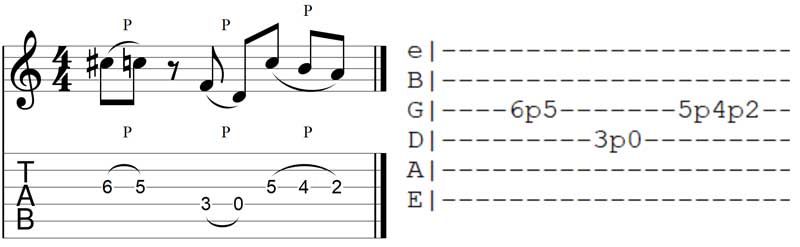
P in Guitar Tabs Compared With Other Symbols
Guitar tabs use several symbols to describe techniques. Knowing the difference helps you read a complete riff.
| Symbol | Meaning | Basic action |
|---|---|---|
p |
Pull-off | Move from a higher fret to a lower fret without picking again |
h |
Hammer-on | Move from a lower fret to a higher fret without picking again |
/ |
Slide up | Slide the fretting finger toward a higher fret |
\ |
Slide down | Slide the fretting finger toward a lower fret |
b |
Bend | Raise the pitch by pushing or pulling the string |
~ |
Vibrato | Vary the pitch with a small finger motion |
x |
Muted note | Touch the string without fully fretting it |
P.M. |
Palm mute | Rest the picking-hand palm lightly near the bridge |
The difference between p and P.M. matters. A lowercase p between fret numbers usually means pull-off. The letters P.M. above or below a passage usually mean palm muting.
For example:
e|--5p3--|
This uses a pull-off.
P.M.----------------|
e|--5--5--5--5------|
This asks you to mute the notes with your picking-hand palm.
If you are still wondering what does p mean in guitar tabs after seeing a symbol, inspect its position. A symbol between two fret numbers usually describes how those notes connect. A marking above a repeated riff may describe the tone or picking style.

When P Does Not Mean Pull-Off
Pull-off is the standard meaning, but context always matters.
The most common alternative is palm mute. Some beginner tabs write p or PM instead of the more complete P.M. notation. Palm muting is played by placing the edge of your picking-hand palm close to the bridge while you pick.
You may also see “p” in chord charts, lessons, or tablature software as a shortcut for a performance instruction. The software’s legend or song notes should explain unusual symbols.
Look for these clues:
• 5p3 usually means pull-off.
• 7p5p3 means several pull-offs.
• P.M. above a line usually means palm mute.
• A lowercase p beside a picking pattern may require the tab’s legend.
• A recording can confirm whether the notes are connected or muted.
This is why the answer to what does p mean in guitar tabs is “usually a pull-off,” rather than “always a pull-off.” Tab notation is less standardized than traditional sheet music.

Practice Exercises for Pull-Offs
Practice on one string first. This removes extra movement and lets you focus on sound.
Exercise one: even two-note pull-offs
e|--5p3--5p3--5p3--5p3--|
B|-----------------------|
G|-----------------------|
D|-----------------------|
A|-----------------------|
E|-----------------------|
Pick each fifth-fret note. Make every third-fret note clear and close in volume.
Exercise two: descending three-note pattern
e|--7p5p3--7p5p3--7p5p3--|
B|------------------------|
G|------------------------|
D|------------------------|
A|------------------------|
E|------------------------|
Keep the fifth- and third-fret fingers in place as long as possible. This helps your hand prepare for the next note.
Exercise three: move across strings
e|--5p3----------------|
B|-------5p3-----------|
G|------------5p3------|
D|----------------5p3--|
A|---------------------|
E|---------------------|
Mute each string after the phrase ends. This exercise builds control and helps you move through guitar riffs.
Exercise four: add a metronome
Play one pull-off on each beat. Then play two pull-offs per beat. Increase the tempo by only a few beats per minute when the sound stays clean.
A short daily session works well. Five focused minutes can teach your fingers more than 30 minutes of rushed playing.

Pull-Offs in Different Guitar Styles
Pull-offs appear in many styles, but each style uses them in a slightly different way.
Rock guitar often uses pull-offs in pentatonic solos. A phrase such as 8p5 on the high E string can create a fast, vocal sound.
Blues players use pull-offs to decorate a held note. They may pick a fretted note, pull off to an open string, and then add vibrato or a bend.
Metal guitar uses rapid pull-off sequences. These passages require strong synchronization between both hands and often use high gain, which can make unwanted noise more noticeable.
Acoustic guitarists use pull-offs in folk, country, and fingerstyle patterns. On an acoustic guitar, the fretting hand must create enough energy because the second note is not picked.
The technique stays the same, but the tone, speed, and rhythm change. That is another reason what does p mean in guitar tabs should be understood as a playing action, not just a letter.

How Tab Accuracy Affects Pull-Offs
Free guitar tabs can be useful, but their quality varies. Some tabs have wrong fret numbers, missing rhythm marks, or unclear technique symbols.
For better results:
• Compare the tab with the original recording.
• Check whether the notes are on the correct string.
• Look for a version with rhythm stems or standard notation.
• Use tabs from trusted publishers or experienced transcribers.
• Slow the recording down without changing its pitch.
• Watch a clear performance when the written instructions seem incomplete.
Tabs often show where to play a note but not how long to hold it. They may also omit finger numbers and muting instructions. Treat tab as a useful map, not a complete substitute for listening.
When I work through a new tab, I first identify every technique mark. Then I play the riff slowly and compare the sound with the recording. This prevents the common mistake of memorizing an incorrect motion.
Frequently Asked Questions About What Does P Mean in Guitar Tabs
Does “p” always mean pull-off in guitar tabs?
No. It usually means pull-off when it appears between fret numbers, such as 5p3. In some tabs, p may refer to palm muting, so check the notation key and surrounding symbols.
Do you pick the second note in a pull-off?
No. You normally pick the first, higher note only. Your fretting finger creates the second note by pulling off to the lower fret.
What is the difference between “p” and “h” in tabs?
The letter p means pull-off, which moves from a higher fret to a lower fret. The letter h means hammer-on, which moves from a lower fret to a higher fret.
Why does my pull-off sound weak?
Your lower fret may not be held firmly, or your finger may be lifting straight up. Keep the lower note pressed and use a small sideways motion as you release the higher note.
Can you play a pull-off on an open string?
Yes. A tab such as 3p0 means play the third fret, then pull off to the open string. Keep other fingers and your picking hand from touching the open string.
What does “P.M.” mean in guitar tabs?
P.M. means palm mute. You lightly rest the edge of your picking-hand palm near the bridge while picking to create a short, muted tone.
Are pull-offs used on acoustic and electric guitars?
Yes. Pull-offs work on both types of guitar. Electric guitars may make them easier to hear because of amplification, while acoustic players often need a more precise fretting-hand motion.
Conclusion
The answer to what does p mean in guitar tabs is usually simple: it means pull-off. Pick the higher note, release it with a small controlled motion, and let the lower fret or open string sound without picking again.
Remember that p can sometimes refer to palm muting, especially when it appears as P.M. above a passage. Read the full tab, listen to the song, and practice each phrase slowly with a relaxed hand.
Try the exercises today, then apply the technique to a riff you enjoy. Keep exploring reliable tabs and share your favorite pull-off exercise or question in the comments.

Senior Music Reviewer
Alex Carter is a seasoned music reviewer with over a decade of experience in the world of sound and instruments. Passionate about helping musicians and enthusiasts make informed choices, he brings sharp insights and in-depth knowledge to every review. From classical instruments to modern gear, Alex combines technical expertise with a love for music to deliver content that resonates with readers.
As a Senior Music Reviewer and expert author on Tuneluma.com, Alex is dedicated to sharing honest evaluations, practical advice, and thoughtful commentary to guide readers in their musical journey.