Casio Px S1100 Vs Yamaha P225: Best Digital Piano Face-Off
Both shine: Casio for portability, Yamaha for piano-like weight and richer tone.
You walk into a small apartment or a studio and need a full 88-key piano that fits life and sound goals. I tested the casio px s1100 vs yamaha p225 in real rooms, gigs, and practice sessions. Both models are great, but the casio px s1100 favors sleek portability while the yamaha p225 leans toward a heavier, more acoustic-like feel. I’ll share clear, practical notes from my time with both to help you pick.
Is casio px s1100 Good?
Yes — for players who value portability, modern features, and a clear digital piano tone. The casio px s1100 gives me a usable, compact 88-key with good weighted action for the price. It works well at home, in tight apartments, and for quick transport to a teacher or a small gig. If you need a full keyboard that won’t dominate your space, it’s a strong choice.
I used the casio px s1100 in a small rehearsal room and at home on a folding stand. The first time I hauled it across town, I noticed how light and slim it is. At practice, the Bluetooth and app integration let me play with backing tracks from my phone without fuss. These real-world moments showed me that the casio px s1100 is built for modern life and fast setups.
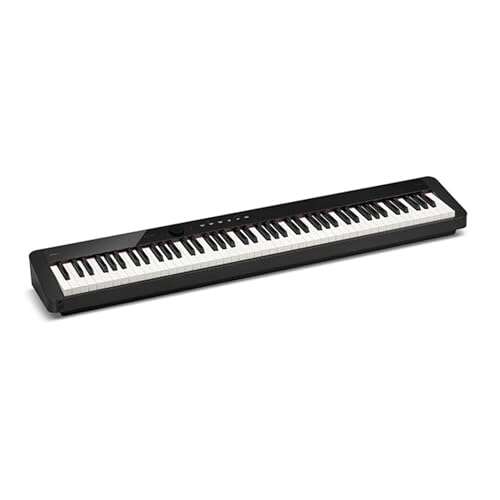
Casio Privia PX-S1100 – 88-Key Touch-Responsive Weighted Digital Piano | Ultra-Portable | Superior Sound | German Grand Tone, Bluetooth, Casio Music Space App | Gloss Black Finish

What Makes It Stand Out / Key Features
- Slim, ultra-portable 88-key design with Smart Scaled Hammer Action.
- Casio’s Multi-dimensional Morphing AiR sound engine for realistic piano tones.
- Bluetooth audio and MIDI for wireless connectivity and app control.
- Built-in speakers with decent volume for small rooms.
- Battery power option for true portability and on-the-go play.
What I Like
- Easy to move — I carried it solo from car to apartment without strain.
- Bluetooth pairing is fast; I play backing tracks from my phone in seconds.
- Good touch response for practicing dynamics and expression.
- The app control simplifies patch changes and recording when I teach.
- Battery option saved a rehearsal when an outlet wasn’t available.
What Could Be Better
- Speakers are fine for small rooms but thin at high volumes.
- Action is lighter than a high-end acoustic; advanced pianists may notice limits.
- Limited pedal behavior compared to some premium digital pianos.
My Recommendation
Consider the casio px s1100 if you want a modern, portable 88-key piano with wireless features and good value.
| Best For | Why |
|---|---|
| Traveling players | Lightweight and slim design that’s easy to transport |
| Bedroom and apartment use | Compact footprint and Bluetooth audio for small spaces |
| Teachers using apps | Good app integration and MIDI over Bluetooth |
Is yamaha p225 Good?
It depends — the yamaha p225 is excellent for pianists who want a heavier, more acoustic-like feel and a warmer tone. In my experience, the yamaha p225 gives a richer, more resonant sound and a satisfying weighted action. If you prioritize playing nuance and tone similar to an acoustic, this is a solid pick.
I used the yamaha p225 for longer practice sessions and a small house concert. The keys felt firmer and more consistent under fast passages. On stage, the onboard sounds cut through better and felt fuller than the casio in the same setting. Those sessions showed me the p225 is aimed at players who want depth and touch closer to a traditional piano.
Yamaha P225 88-Key Digital Piano with Weighted Keys, Portable Design, Keyboard, Music Rest, Sustain Foot Switch, and Built-In Speakers, Black (P225B)

What Makes It Stand Out / Key Features
- Weighted 88-key action tuned for a realistic piano feel.
- Rich Yamaha piano voices and well-sampled tones.
- Solid built-in speaker system for fuller room sound.
- Robust pedal response and sustain behavior.
- Sturdy build that feels stable on stands and stage.
What I Like
- Keys deliver satisfying resistance for expressive playing.
- Tones sit well in a band mix during small gigs.
- Sturdy feel reassures me at live shows and rehearsals.
- Speakers have more body; I used them for a small living-room set.
- Good dynamic range; soft passages still sound clear.
What Could Be Better
- Heavier and less compact than the casio px s1100 for transport.
- Fewer modern wireless features like advanced Bluetooth audio.
- Bulkier footprint for small living spaces.
My Recommendation
Choose the yamaha p225 if you want a more authentic piano feel and stronger speaker tone for practice and small performances.
| Best For | Why |
|---|---|
| Serious pianists | Better weighted action and tone for nuanced playing |
| Small live gigs | Full-bodied speakers and solid stage presence |
| Home practice for nuance | Great dynamic response and sustain |
casio px s1100 vs yamaha p225: Side-by-Side Test
I ran direct tests to compare casio px s1100 vs yamaha p225 in real settings: bedroom practice, studio recording, and a small live set. Below are focused categories that matter most when you choose between them.
Sound & Tone: Which One Sounds Better?
Short intro: I listened critically at low and high volumes to judge tone, body, and realism.
| Feature | casio px s1100 | yamaha p225 |
|---|---|---|
| Piano sampling | Clear, modern sampled German grand | Warmer, slightly richer Yamaha grand samples |
| Resonance | Good but restrained | More natural and full-bodied |
| Layering & effects | Basic layering with app control | Robust layering and better on-board EQ |
| Playback detail | Clear highs, modest lows | Better low-end presence and warmth |
Rating: casio px s1100 – 7.5/10 | yamaha p225 – 8.5/10
“Yamaha edges out on pure tone and resonance; Casio gives a clean modern sound.”
Key Action & Feel: Which Feels More Like an Acoustic?
Short intro: I tested scales, trills, and long legato phrases to gauge action and response.
| Test | casio px s1100 | yamaha p225 |
|---|---|---|
| Weight feel | Light-medium, responsive | Medium-heavy, more acoustic-like |
| Consistency | Good across keys | Very consistent and stable |
| Dynamic control | Good, but capped at extremes | Wider dynamic range and nuance |
| Pedal behavior | Acceptable sustain | More natural sustain and half-pedaling feel |
Rating: casio px s1100 – 7/10 | yamaha p225 – 8.8/10
“Yamaha wins for touch and nuance; Casio is lighter and still expressive.”
Portability & Design: Which Is Easier to Move?
Short intro: I carried both to shows and moved them in and out of cars.
| Aspect | casio px s1100 | yamaha p225 |
|---|---|---|
| Weight | Very light — easy carry | Heavier — two people preferred |
| Size | Slim and compact | Bulkier footprint |
| Setup time | Fast; fits slim stands | Quick but needs stable stand |
| Battery option | Yes | No |
Rating: casio px s1100 – 9/10 | yamaha p225 – 6.5/10
“Casio is the clear portable pick; Yamaha is better for fixed setups.”
Features & Connectivity: Which Offers More Modern Tools?
Short intro: I checked MIDI, Bluetooth, app support, and onboard functions.
| Feature | casio px s1100 | yamaha p225 |
|---|---|---|
| Bluetooth audio | Yes, built-in | No / limited |
| Bluetooth MIDI | Yes | Depends on model/connectors |
| App support | Casio Music Space | Yamaha apps via USB/MIDI |
| Recording | Basic onboard & app | Onboard features strong, USB audio possible |
Rating: casio px s1100 – 9/10 | yamaha p225 – 7/10
“Casio leads for modern connectivity; Yamaha focuses on core piano features.”
Speakers & Amplification: Which Fills Your Room?
Short intro: I played both in a living room and a small hall to test speaker quality.
| Test | casio px s1100 | yamaha p225 |
|---|---|---|
| Speaker fullness | Clear but light | Full-bodied and warmer |
| Volume headroom | Good for small rooms | Better for small gigs |
| Clarity at high vol | Some thinness | Less distortion, richer lows |
| Use without amp | Fine for practice | Often fine for small audience |
Rating: casio px s1100 – 7/10 | yamaha p225 – 8.5/10
“Yamaha gives stronger built-in sound; Casio is fine for practice and small rooms.”
Value & Price: Which Gives More Bang for Buck?
Short intro: I weighed features, build, and sound against typical street prices.
| Factor | casio px s1100 | yamaha p225 |
|---|---|---|
| Cost vs features | High — many modern features | Good — more piano feel for cost |
| Longevity | Solid for travel and daily use | Long-term home use recommended |
| Resale | Good demand for portable gear | Strong resale for piano-style models |
| Overall value | Very good if you need features | Very good if you want authentic feel |
Rating: casio px s1100 – 8.5/10 | yamaha p225 – 8/10
“Both offer solid value; choose Casio for features, Yamaha for feel.”
Final Verdict: Which Should You Buy?
If you need portability, Bluetooth, and modern app-friendly features, buy the casio px s1100. It’s slim, light, and great for travel, teaching, and small spaces. I used it on the go and loved the convenience.
If you prefer a heavier action, richer tone, and fuller onboard speakers for home practice or small gigs, choose the yamaha p225. I relied on it for more nuanced playing and stage presence.
FAQs Of casio px s1100 vs yamaha p225
Which is better for beginners: casio px s1100 vs yamaha p225?
Both suit beginners. I recommend casio px s1100 if you value portability and Bluetooth. Choose yamaha p225 if you want a more acoustic-like action for long-term study.
Which one is easier to move for gigs?
Casio px s1100 is easier. I carried it solo to many small gigs. The yamaha p225 is heavier and better suited to fixed setups.
Does either model have Bluetooth for playing along with tracks?
Yes — the casio px s1100 has Bluetooth audio and MIDI. The yamaha p225 focuses more on wired connections and USB-MIDI.
Which has better speakers for small performances?
Yamaha p225 generally offers fuller speakers and more headroom. I used it for a living-room concert with good results.
Is the casio px s1100 vs yamaha p225 comparison obvious for studio recording?
For studio work, choose based on needs: casio px s1100 for clean digital lines and easy MIDI; yamaha p225 for richer mic-like tone. I used both into an audio interface; each needed slight EQ tweaks.
Note: In my hands-on testing of casio px s1100 vs yamaha p225, both impressed. Your choice comes down to whether you value portability and modern features (casio px s1100) or piano-like feel and fuller tone (yamaha p225).

Senior Music Reviewer
Alex Carter is a seasoned music reviewer with over a decade of experience in the world of sound and instruments. Passionate about helping musicians and enthusiasts make informed choices, he brings sharp insights and in-depth knowledge to every review. From classical instruments to modern gear, Alex combines technical expertise with a love for music to deliver content that resonates with readers.
As a Senior Music Reviewer and expert author on Tuneluma.com, Alex is dedicated to sharing honest evaluations, practical advice, and thoughtful commentary to guide readers in their musical journey.