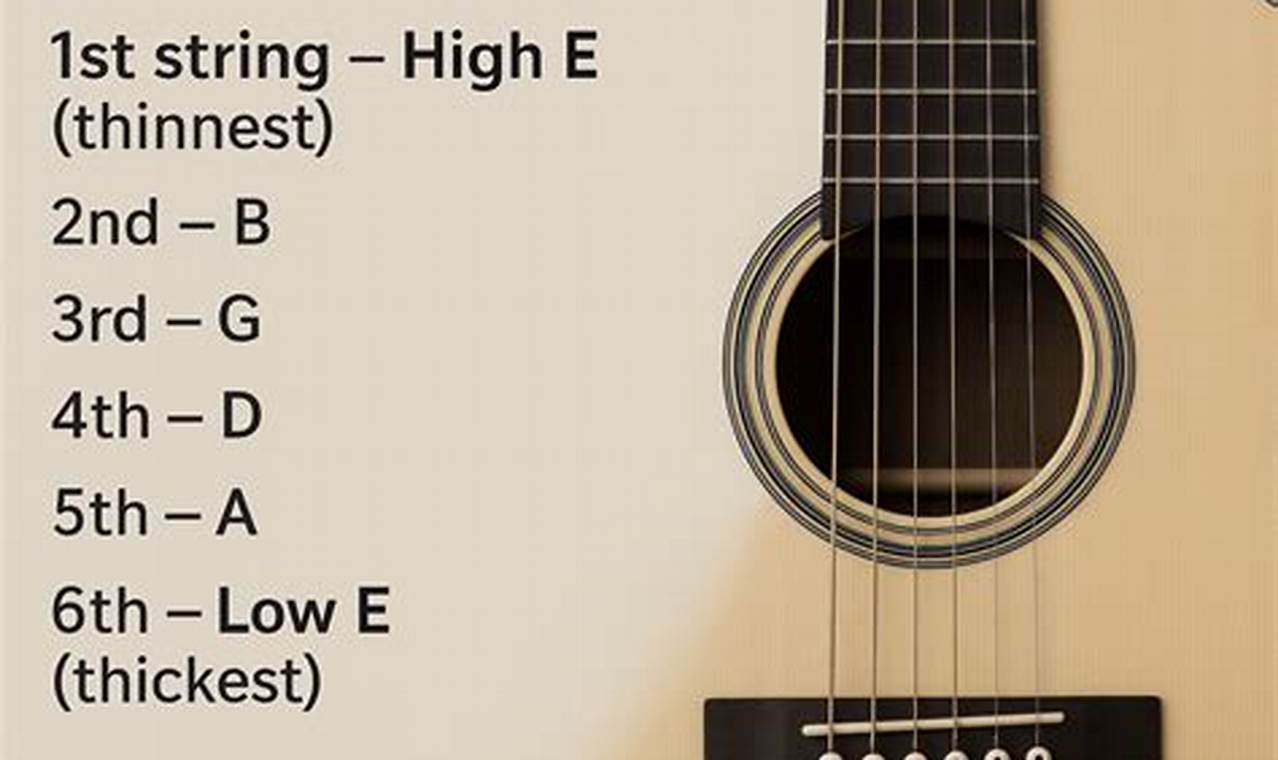
For a standard six-string guitar in the United States, the string order is E-A-D-G-B-E from the thickest string to the thinnest string. The thickest string is the low E string. The thinnest string is the high E string.
When you hold the guitar in playing position, the strings appear in this order from top to bottom:
| String number | Note | Common name | Relative pitch |
|---|---|---|---|
| 6 | E | Low E | Lowest |
| 5 | A | A string | |
| 4 | D | D string | |
| 3 | G | G string | |
| 2 | B | B string | |
| 1 | E | High E | Highest |
The two E strings have the same letter name, but they are two octaves apart. One is thick and low; the other is thin and high.
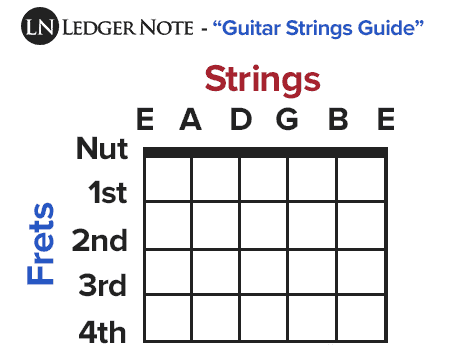
Guitar String Order From Thickest to Thinnest
The standard guitar string order is E, A, D, G, B, E. Guitar players often say this as “low E to high E.”
The low E string is also called the sixth string. The high E string is the first string. This can feel backward at first because the lowest note has the highest string number.
Here is the basic order again:
- Sixth string: low E
- Fifth string: A
- Fourth string: D
- Third string: G
- Second string: B
- First string: high E
The number tells you the string’s position in guitar notation. It does not tell you the pitch. String 6 is the lowest-pitched string, while string 1 is the highest-pitched string.
A simple visual layout
When you look down at a right-handed guitar in playing position, the strings usually appear like this:
Top edge of guitar
6th string — Low E — thickest
5th string — A
4th string — D
3rd string — G
2nd string — B
1st string — High E — thinnest
Bottom edge of guitar
For a left-handed guitar, the physical layout is reversed from the player’s viewpoint. However, the string names and numbers still follow the same musical system: string 6 is low E, and string 1 is high E in standard tuning.
Why Guitar Strings Have This Order
The strings are arranged from low pitch to high pitch to give the guitar a wide, useful range of notes. Lower notes need thicker strings and lower tension. Higher notes work well with thinner strings.
The open strings in standard tuning are spaced as follows:
- E to A: a perfect fourth
- A to D: a perfect fourth
- D to G: a perfect fourth
- G to B: a major third
- B to high E: a perfect fourth
The interval between the third and second strings is different. The G-to-B major third helps make many common chords easier to play. It also explains why some chord shapes and scale patterns change slightly when they cross from the G string to the B string.
The order also supports common guitar techniques. Chords use several strings at once, while scales and melodies move across the strings in a predictable pitch pattern. Once you know E-A-D-G-B-E, chord charts, tablature, and tuning instructions become much easier to read.
How to Remember the Guitar String Order
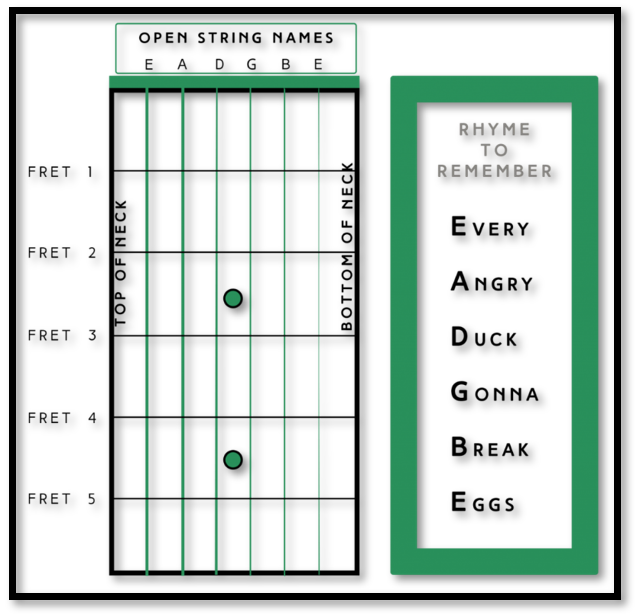
The most common memory phrase for the strings from low to high is:
Eddie Ate Dynamite, Good Bye Eddie
The first letter of each word gives you:
- Eddie = E
- Ate = A
- Dynamite = D
- Good = G
- Bye = B
- Eddie = E
You can also use a phrase for the string numbers from high to low:
Eddie Bought Dynamite, Good-bye Eddie
The exact phrase does not matter. What matters is remembering the pattern E-A-D-G-B-E.
Another useful method is to say the strings while touching them. Start with the thickest string and say:
“Six, five, four, three, two, one: E, A, D, G, B, E.”
This connects the string number, physical position, and note name at the same time.
Use the two E strings as anchors
The two E strings are easy reference points:
- The thickest string is low E.
- The thinnest string is high E.
From the low E, move toward the floor: A, D, G, B, E. From the high E, move toward the ceiling: B, G, D, A, E.
This method can help when you are changing strings, reading tablature, or checking whether your guitar is upside down in a diagram.

Which Guitar String Is Which?
The easiest way to identify a guitar string is to compare its thickness and location.
| How to identify it | String |
|---|---|
| Thickest string | Low E, string 6 |
| Next thickest | A, string 5 |
| Middle-low string | D, string 4 |
| Middle-high string | G, string 3 |
| Thin string next to the high E | B, string 2 |
| Thinnest string | High E, string 1 |
Thickness is a useful guide, but it is not a complete test. String sets can use different gauges, and some strings may be wound or plain. A light-gauge set may look thinner than a heavy-gauge set, but the order remains the same.
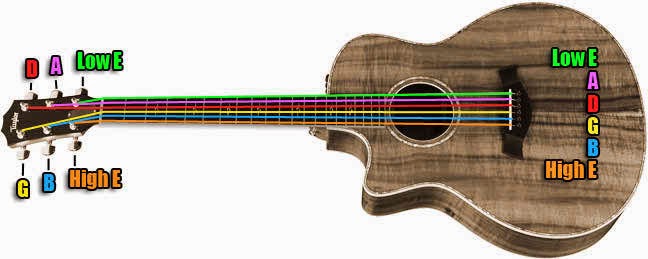
The tuning peg position can also help. On many guitars, the low E, A, and D strings use tuning machines on one side of the headstock, while the G, B, and high E strings use machines on the other side. Some guitars use a different headstock design, so do not rely on peg position alone.
What Does EADGBE Mean in Guitar Tuning?
EADGBE is the note pattern for standard tuning on a six-string guitar. It describes the pitch of each open string, from the lowest string to the highest:
6th string: E
5th string: A
4th string: D
3rd string: G
2nd string: B
1st string: E
“Open” means that you play the string without pressing it against a fret.
A tuner may show octave numbers as well. A common scientific pitch notation for standard tuning is:
- Low E: E2
- A: A2
- D: D3
- G: G3
- B: B3
- High E: E4
Some tuner apps display note names in a different format. The octave label may vary by device, but the letter order remains E-A-D-G-B-E.
Standard tuning is not the only tuning
Many guitarists use alternate tunings. For example:
| Tuning | Lowest-to-highest strings | Common use |
|---|---|---|
| Standard | E-A-D-G-B-E | General guitar playing |
| Drop D | D-A-D-G-B-E | Rock, metal, and easy power chords |
| Half-step down | E♭-A♭-D♭-G♭-B♭-E♭ | Lower overall pitch |
| Open G | D-G-D-G-B-D | Blues, slide, and open chords |
| Open D | D-A-D-F♯-A-D | Slide guitar and open chords |
The physical string order does not change when you retune. Only the notes change.
How Guitar String Numbers Work in Tabs and Chord Charts
Guitar tablature uses six horizontal lines. The bottom line usually represents the low E string, and the top line represents the high E string.
A tab diagram is normally read like this:
High E  e|----------------|
B       B|----------------|
G       G|----------------|
D       D|----------------|
A       A|----------------|
Low E   E|----------------|
This can seem opposite to the way the guitar looks when you hold it. The bottom tab line is the low E string, while the top tab line is the high E string.
Numbers on a tab line tell you which fret to play. A 0 means play the open string. For example:
e|--0--|
This means play the open high E string.
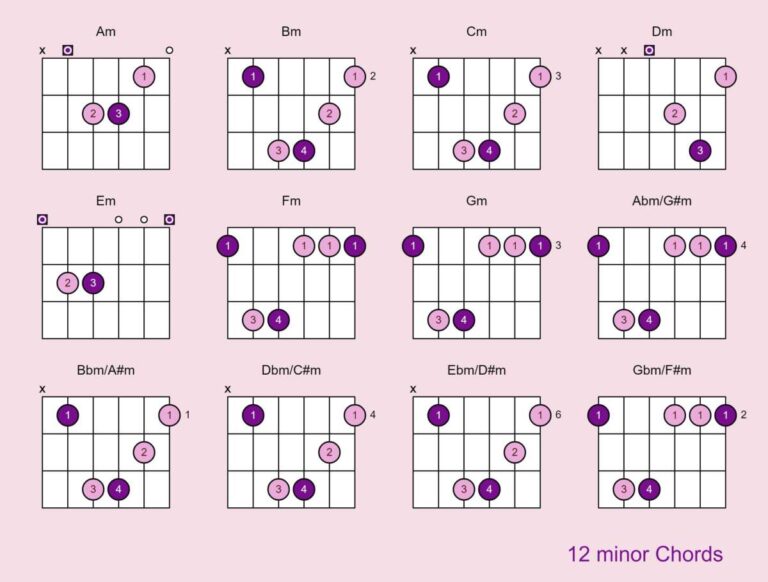
Chord diagrams use another view. The vertical lines show strings, and the horizontal lines show frets. Most diagrams label the low E string on the left and the high E string on the right when viewed on the page.
Always check the diagram’s labels. Some charts place the low E on the opposite side to match a left-handed view.
How to Put New Guitar Strings in the Correct Order
Before replacing strings, check the package label. Most six-string sets list the strings by gauge and identify them with note names or numbers.
Install the strings in this order:
- Place the thickest string in the low E position.
- Place the next string in the A position.
- Continue with D, G, B, and high E.
- Tune each string close to pitch.
- Stretch the strings gently and retune.
Do not force a string to reach a note if it feels unusually tight. A string may be in the wrong position, or the tuner may be reading the wrong octave. Stop and check the string order before turning the tuning peg further.
A new string may go flat several times as it settles. Tune it again rather than turning it far above the target note. A string that is pushed too high can break and may cause injury near the face or eyes.
How to tell if a string is in the wrong position
Common signs include:
- The thickest string is being tuned to high E.
- A string feels much tighter or looser than expected.
- The tuner shows the wrong note even after large adjustments.
- The guitar sounds unusually sharp, dull, or unbalanced.
- A replacement string does not fit the expected bridge or tuning post.
If a string breaks during installation, move your face and hands away from the string path. Remove the broken piece carefully and inspect the bridge, nut, and tuning post for sharp edges.
Do Acoustic and Electric Guitars Use the Same String Order?
Most standard six-string acoustic and electric guitars use the same string order: E-A-D-G-B-E.
The main difference is the string material, construction, and gauge. Acoustic guitar strings often use bronze or phosphor bronze wound strings. Electric guitar strings often use nickel-based alloys or other materials. Classical guitars use nylon or composite treble strings and wound bass strings.
These material differences do not change the basic note order. They can change the feel, tone, tension, and the type of guitar that can safely use the set.
Do not put steel strings on a classical guitar unless the instrument maker specifically allows it. Steel strings create much more tension and can damage a classical guitar’s neck or bridge.
Does a 7-String or 12-String Guitar Use the Same Order?
A standard seven-string guitar usually adds a lower string below the low E. A common tuning is:
B-E-A-D-G-B-E
The low B is string 7, followed by the usual six-string pattern. Some players use other tunings, so check the instrument’s tuning before replacing strings.
A 12-string guitar has six courses. Each course contains two strings. The two strings may be tuned in unison or an octave apart, depending on the course.
A common 12-string arrangement from low to high is:
- Low E course: E with a higher E
- A course: A with a higher A
- D course: D with a higher D
- G course: G with a higher G
- B course: B and B
- High E course: E and E
The exact octave arrangement can vary by instrument and string set. Use the manufacturer’s guide when changing 12-string sets.

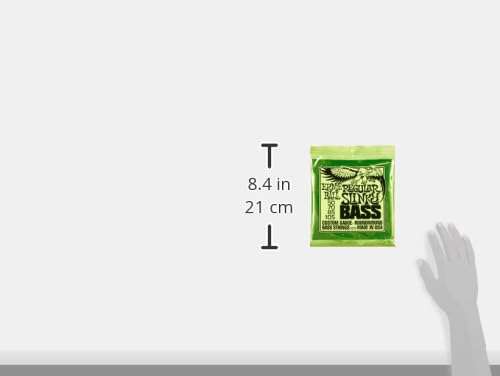
What Is the String Order on a Bass Guitar?
A standard four-string bass uses:
E-A-D-G
This is the same low-to-high pattern as the bottom four strings of a guitar. The bass strings are much thicker and are tuned one octave lower than the corresponding guitar strings.
A five-string bass commonly uses:
B-E-A-D-G
A six-string bass commonly uses:
B-E-A-D-G-C
Bass string numbers also run from the highest number at the lowest string to string 1 at the highest string. A four-string bass has string 4 as low E and string 1 as high G.
Do not use a bass string set on a standard guitar. The length, tension, and gauge are different.
Common Mistakes With Guitar String Order
The most common mistake is confusing string number with string pitch. Remember that string 6 is low E, while string 1 is high E.
Another mistake is reading tablature upside down. The top line of a tab normally shows the high E string. The bottom line shows the low E string.
Players also sometimes assume that every guitar is in standard tuning. A guitar may be tuned to Drop D, open G, or another setup. If the open strings sound different, check the tuning before changing the strings.
Finally, do not choose a replacement string only by its appearance. Use the correct string set for the guitar type, scale length, tuning, and playing style. If the guitar uses a floating tremolo or another complex bridge, replacing strings one at a time may help preserve bridge balance.

Key Takeaways
- The standard six-string guitar order is E-A-D-G-B-E.
- The thickest string is the low E, also called string 6.
- The thinnest string is the high E, also called string 1.
- Guitar string numbers run from 6 at the lowest string to 1 at the highest string.
- Standard tuning is not the same as every possible guitar tuning.
- Acoustic, electric, and classical guitars use the same basic note order, but they need different string types.
- A standard four-string bass uses E-A-D-G, one octave lower than the matching guitar strings.
Frequently Asked Questions
Which guitar string is the first string?
The first string is the high E string. It is the thinnest string and has the highest pitch in standard tuning.
Which guitar string is the thickest?
The sixth string, known as the low E string, is usually the thickest string on a standard six-string guitar.
Is the low E string on top or bottom?
When you hold a right-handed guitar in playing position, the low E string is usually closest to the top edge of the guitar. In guitar tablature, however, the low E string is shown on the bottom line.
Are the two E strings the same note?
They have the same letter name, but they are not the same pitch. In standard tuning, the high E is two octaves above the low E.
What is the easiest way to tune a guitar by ear?
Use the fifth-fret method for most neighboring strings:
- Fifth fret on low E matches open A.
- Fifth fret on A matches open D.
- Fifth fret on D matches open G.
- Fourth fret on G matches open B.
- Fifth fret on B matches open high E.
An electronic tuner is more reliable, especially for beginners or noisy rooms.
What should I do if I cannot tell which string I need?
Check the string number, note name, and gauge printed on the package. If the old string is still attached, compare its position and thickness. For a guitar with unusual tuning, scale length, or bridge hardware, use the instrument maker’s string chart.
Conclusion
The standard guitar string order is E-A-D-G-B-E, moving from the thickest, lowest string to the thinnest, highest string. The low E is string 6, and the high E is string 1.
Start by learning the two E strings, then fill in A, D, G, and B between them. Once the order feels familiar, use it to read tabs, tune your guitar, identify replacement strings, and understand chord diagrams.
Further reading
- Fender: How to Tune a Guitar
- Gibson: Guitar Tuning Guide
- Martin Guitar: String and Tuning Resources
- Yamaha: Guitar Fundamentals

Senior Music Reviewer
Alex Carter is a seasoned music reviewer with over a decade of experience in the world of sound and instruments. Passionate about helping musicians and enthusiasts make informed choices, he brings sharp insights and in-depth knowledge to every review. From classical instruments to modern gear, Alex combines technical expertise with a love for music to deliver content that resonates with readers.
As a Senior Music Reviewer and expert author on Tuneluma.com, Alex is dedicated to sharing honest evaluations, practical advice, and thoughtful commentary to guide readers in their musical journey.