Yamaha P45 Vs P145: Side-By-Side Comparison Guide
Both are excellent 88-key Yamahas; P45 is simple and budget-friendly, P145 adds polish and Bluetooth.
You sit at a small apartment keyboard and wonder: do you need extra features or just solid keys? I tested the Yamaha P45 and the Yamaha P145 in real home practice and light gig setups. In this yamaha p45 vs p145 comparison I'll share what felt better under my hands, which sounds more alive, and which fits common needs. Both are good, but one favors simplicity while the other leans toward modern convenience.
Is Yamaha P45 Good?
I say yes — for many players the Yamaha P45 is a clear winner. It is a no-nonsense, entry-level 88-key digital piano that focuses on good weighted action and honest piano tone. If you are a beginner, a student, or someone who wants a compact practice instrument, the P45 is a reliable pick. In my home, the P45 sat in a small nook for months. I used it for sight-reading practice and simple repertoire. Its compact footprint fit my space and I never felt it missing any essential piano feel.
One afternoon I moved the P45 to a living-room jam with a guitar and a singer. The P45 handled chord work well and stayed tuned in tone between songs. Another time I packed it into my car for a short lesson gig. It was lightweight and easy to set up. For pure practice value and low cost, P45 checks the boxes. In my yamaha p45 vs p145 tests, the P45 showed that a basic, focused instrument can still deliver satisfying playability without extras getting in the way.

What Makes It Stand Out / Key Features
- 88 full-size weighted GHS (Graded Hammer Standard) keys for realistic touch.
- Pure, focused piano Grand Piano Voice with decent speaker output.
- Basic control layout—power, volume, and a few buttons for voices and metronome.
- Compact, lightweight design—easy to move and set up.
- Affordable price point for an 88-key weighted Yamaha.
What I Like
- Natural weighted feel that helps build finger strength and technique.
- Simple interface—no learning curve or menus to dig through.
- Reliable tone for practice and simple performance.
- Easy to transport for lessons or small gigs.
- Great value if you want a playable 88-key piano without extras.
What Could Be Better
- No Bluetooth or modern wireless features for audio/MIDI.
- Speakers are fine for practice but lack depth for performance use.
- Limited voices and no advanced practice modes.
My Recommendation
Choose the P45 if you need a straightforward, budget 88-key piano for home practice or lessons.
| Best For | Why |
|---|---|
| Beginners & Students | Affordable, realistic weighted keys for learning technique. |
| Small-space players | Compact design fits apartments and practice corners. |
| Portable gigging | Lightweight and simple to set up for short shows. |
Is Yamaha P145 Good?
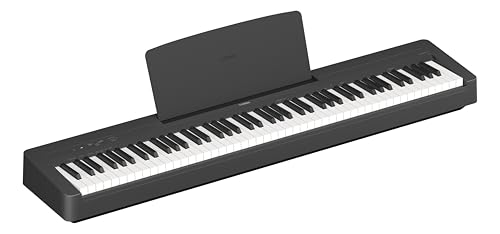
My verdict: it depends on the extra features you want. The Yamaha P145 feels like the P45 matured. It keeps the same core strengths—good weighted keys and Yamaha piano tone—but adds modern touches that I found useful. If you want Bluetooth audio/MIDI, slightly improved speaker tuning, and a cleaner interface, the P145 nudges ahead. In my yamaha p45 vs p145 sessions, the P145 gave me cleaner connections to my phone and tablet for practice apps.
I remember pairing the P145 to my phone and running a practice app without cables. That brief freedom of movement made a lesson feel smoother. Another evening I compared the P145 and P45 side-by-side; the P145 had a slightly fuller voice and a touch more low-end in the room. For a home player who values small conveniences and future-proofing, the P145 is a compelling step up from the P45.
What Makes It Stand Out / Key Features
- 88 weighted keys with Yamaha’s realistic hammer action.
- Bluetooth audio and MIDI connectivity for wireless practice.
- Improved speaker voicing for clearer midrange and bass.
- Compact design with added modern controls and sustain pedal input.
- Multiple piano voices and basic practice tools built-in.
What I Like
- Bluetooth lets me use mobile apps without cables.
- Slightly richer tone in small rooms versus the P45.
- Same comfortable key action as P45 with added polish.
- Good balance between features and simplicity.
- Better long-term value if you want connectivity.
What Could Be Better
- Not a full-featured stage piano—still limited voices.
- Bluetooth can add tiny latency with some apps.
- Price is higher than P45; consider if extras matter to you.
My Recommendation
Pick the P145 if you want the P45 feel plus Bluetooth and a slightly fuller sound.
| Best For | Why |
|---|---|
| App-driven learners | Bluetooth pairs to phones/tablets for lessons and play-along. |
| Home players wanting polish | Slightly better speaker voicing and modern convenience. |
| Future-proof buyers | Connectivity and refined sound give longer usefulness. |
yamaha p45 vs p145: Side-by-Side Test
I lined the two pianos up and tested common use cases. Below are direct comparisons across key categories. This is based on my practical yamaha p45 vs p145 experience at home and in light gig settings.
Sound & Tone: Which Feels More Piano-Like?
We listen for richness, clarity, and room presence.
| Feature | Yamaha P45 | Yamaha P145 |
|---|---|---|
| Grand piano voice | Warm, focused | Slightly fuller, clearer mids |
| Bass response | Limited in big rooms | Better low-end balance |
| Speaker clarity | Good for practice | Cleaner, more defined |
| Overall presence | Intimate | More room-friendly |
Yamaha P45 – 7/10 | Yamaha P145 – 8/10
> “P145 wins slightly for tone and room presence, giving fuller sound for small performances.”
Key Action & Feel: Which Keys Respond Better?
We test weight, graded feel, and consistency across the keyboard.
| Feature | Yamaha P45 | Yamaha P145 |
|---|---|---|
| Weighted action | GHS graded—realistic | GHS graded—very similar |
| Key consistency | Consistent across keys | Consistent with slightly improved finish |
| Touch nuance | Good for beginners | Better nuance for expressive playing |
| Pedal feel | Basic sustain pedal | Improved sustain response |
Yamaha P45 – 8/10 | Yamaha P145 – 8.5/10
> “Both feel excellent; P145 has a small edge in nuance and pedal response.”
Connectivity & Extras: Which Offers More?
We look at MIDI, Bluetooth, and app support.
| Feature | Yamaha P45 | Yamaha P145 |
|---|---|---|
| Bluetooth audio/MIDI | No | Yes |
| USB/MIDI | Standard MIDI Out | USB/MIDI and Bluetooth |
| Practice features | Metronome, split basic | Metronome, modes, better app support |
| App pairing | Requires cable | Wireless pairing |
Yamaha P45 – 5/10 | Yamaha P145 – 9/10
> “P145 clearly wins on connectivity; it modernizes practice and playback options.”
Build & Portability: Which Moves Easier?
We compare size, weight, and ease of setup.
| Feature | Yamaha P45 | Yamaha P145 |
|---|---|---|
| Weight | Light, very portable | Light, similar to P45 |
| Footprint | Compact | Compact |
| Setup speed | Quick | Quick |
| Durability | Solid for price | Solid with slightly better finish |
Yamaha P45 – 8.5/10 | Yamaha P145 – 8.5/10
> “Tie: both are portable and work well for home use and light transport.”
Practice Features & Usability: Which Helps You Improve?
We test metronome, split/layer, and app integration.
| Feature | Yamaha P45 | Yamaha P145 |
|---|---|---|
| Metronome | Yes, basic | Yes, improved |
| Split/Layer | Limited | Improved options |
| App-friendly | Via cable | Bluetooth makes it easy |
| Useful extras | Minimal | Handy modern tools |
Yamaha P45 – 6.5/10 | Yamaha P145 – 8.5/10
> “P145 helps practice more with wireless app connections and richer features.”
Price & Value: Which Gives More Bang for Buck?
We weigh cost versus practical benefits.
| Factor | Yamaha P45 | Yamaha P145 |
|---|---|---|
| Retail price | Lower, very budget-friendly | Higher, mid-entry price |
| Features per dollar | High for essentials | Good if you value extras |
| Long-term value | Great for simple needs | Better if you want connectivity |
| Which to buy | Best budget choice | Best modern choice |
Yamaha P45 – 8.5/10 | Yamaha P145 – 8/10
> “If price is king, P45 wins. If features matter, P145 may justify the cost.”
Final Verdict: Which Should You Buy?
The P45 is the smart, simple choice. It gives you real weighted keys and honest piano sound at a low price. I recommend it if you mainly practice at home, want a lightweight instrument, or are budget-conscious.
The P145 is better if you want Bluetooth, slightly richer speakers, and modern convenience. In my yamaha p45 vs p145 experience, choose the P145 if you value app pairing and a bit more tonal polish.
FAQs Of yamaha p45 vs p145
What is the main difference between Yamaha P45 and P145?
The P145 adds Bluetooth connectivity and slightly improved speaker voicing. The P45 focuses on basic keys and tone without wireless features.
Which model is better for beginners: P45 or P145?
Both work well. Pick the P45 for budget and simplicity. Choose P145 if you want app pairing and extra practice tools.
Can I use Bluetooth with the P45?
No. The P45 lacks Bluetooth. The P145 supports Bluetooth audio/MIDI for wireless apps and playback.
Which has better sound for small performances?
The P145 has a slight edge in speaker clarity and low-end balance, making it better for small rooms.
Is the key action different between these two?
Both use Yamaha’s graded weighted action and feel similar. The P145 offers a touch more nuance and pedal response in my tests.

Senior Music Reviewer
Alex Carter is a seasoned music reviewer with over a decade of experience in the world of sound and instruments. Passionate about helping musicians and enthusiasts make informed choices, he brings sharp insights and in-depth knowledge to every review. From classical instruments to modern gear, Alex combines technical expertise with a love for music to deliver content that resonates with readers.
As a Senior Music Reviewer and expert author on Tuneluma.com, Alex is dedicated to sharing honest evaluations, practical advice, and thoughtful commentary to guide readers in their musical journey.