Play four core chords (I–vi–IV–V) with a steady groove; left hand anchors, right hand plays melody.
I’ve taught and arranged "Stand by Me" for students and bands for years, so you’ll get clear, practical steps on how to play Stand By Me piano from basics to polished performance. This guide breaks down the chord progression, left-hand patterns, right-hand melody, groove, and easy-to-advanced voicings so you can learn how to play Stand By Me piano and make it sound musical in any setting.

Why "Stand By Me" is perfect for piano players
"Stand By Me" uses a simple, memorable progression that builds musical confidence quickly. The song is driven by a repeating I–vi–IV–V progression, which makes it ideal for practicing harmony, rhythm, and accompaniment. Learning how to play Stand By Me piano teaches you chord function, inversion use, and how to support a singer or play solo.

The core chord progression (readable map)
The song’s harmony is straightforward and easy to transpose. To learn how to play Stand By Me piano, start with this progression in common keys:
- Key of A major: A — F#m — D — E
- Key of C major: C — Am — F — G
- Key of G major: G — Em — C — D
These four chords repeat through most of the song. Practice switching cleanly between them to lock the groove.

Basic left-hand patterns for beginners
A steady left hand gives the song its pulse. Use simple patterns first, then add variations as you improve.
- Root notes only: play one root note per chord on beats 1 and 3.
- Root and fifth: alternate root on beat 1 and fifth on beat 3 for more weight.
- Octave pulse: play octave on beat 1 and single root on beat 3 for a fuller sound.
Start slow. Once comfortable, try moving the left hand with a light swing so the progression breathes.
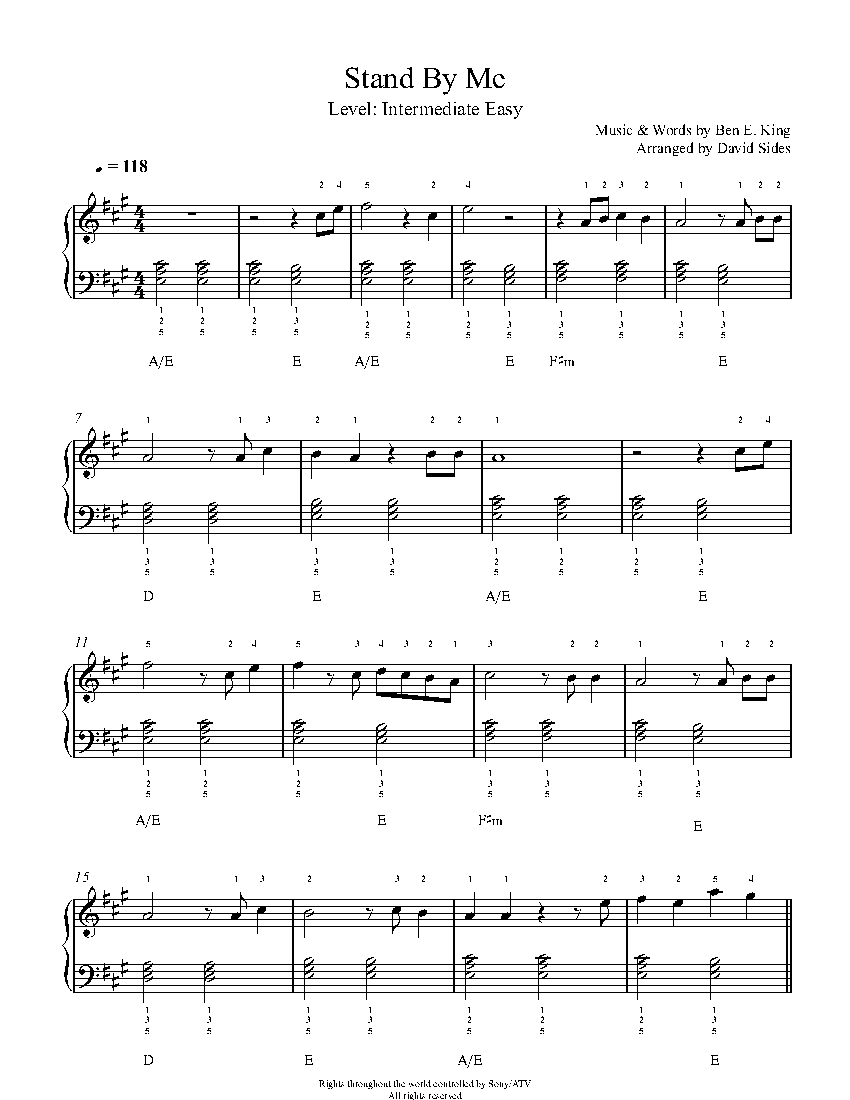
Right-hand melody and simple accompaniment
You don’t need to play every single melody note to make the song recognizable. For how to play Stand By Me piano as a beginner:
- Learn the melody in short phrases, two bars at a time.
- Play triads or broken chords underneath the melody to support it.
- Use block chords on strong beats and fill with arpeggios between vocal phrases.
If you’re accompanying a singer, keep the right hand spacious and rhythmic.

Step-by-step beginner arrangement
Follow these steps to play a full beginner version of how to play Stand By Me piano:
- Learn the chord progression in one key (C or G works well).
- Practice left-hand pattern: root on beat 1, fifth on beat 3.
- Add right-hand block chords on beats 1 and 3.
- Learn the first two-bar melody phrase and match it with the chords.
- Loop the progression slowly and build speed with a metronome.
Repeat sections until chord changes feel automatic. Then add small fills.

Groove, rhythm, and feel
The groove makes the song feel alive. To capture it when learning how to play Stand By Me piano:
- Keep a steady pulse with the left hand.
- Play slightly behind the beat for a relaxed, soulful feel.
- Accent the start of each two-bar phrase to create motion.
- Use light ghost notes or muted hits to add rhythmic interest.
Record yourself to check feel and timing. Small timing changes transform a mechanical performance into something musical.
Advanced voicings and variations
Once you master basics, explore richer sounds to make your version stand out when thinking about how to play Stand By Me piano:
- Use 3rd-in-the-bass inversions for smoother voice leading.
- Add 7th chords (e.g., A7, F#m7) for warmth.
- Try sus2 or sus4 voicings to add color before resolving.
- Use tasteful passing chords between the main chords for movement.
These choices add sophistication without changing the recognizable progression.
Transposing for singers and band settings
Transposition helps everyone sing comfortably. When arranging how to play Stand By Me piano for a vocalist:
- Find the singer’s comfortable range and move the chords into that key.
- Use a capo for guitar parts if the band needs matching keys.
- If you transpose on piano, use familiar keys (C, G, A) first to keep voicings simple.
Practice the progression in three keys to become flexible on the fly.
Practice plan and exercises (30-day outline)
A short plan helps you progress quickly while learning how to play Stand By Me piano:
- Week 1: Learn chord shapes and left-hand patterns at 60 BPM.
- Week 2: Add right-hand block chords and play the melody in short sections.
- Week 3: Increase tempo to performance speed and add simple fills.
- Week 4: Introduce advanced voicings and practice with a singer or backing track.
Daily practice: 20 minutes focused on transitions, 10 minutes on melody, 5–10 minutes improvising.
Common mistakes and how to avoid them
Avoid these pitfalls when learning how to play Stand By Me piano:
- Rushing chord changes — slow down until changes are secure.
- Overplaying the right hand — let the groove and bass breathe.
- Ignoring voice leading — use inversions to smooth chord motion.
- Neglecting dynamics — play softer in verses and stronger in choruses.
Fix these early to save time and sound better faster.
People also ask
How hard is it to learn Stand By Me on piano?
It’s beginner-friendly because the chord progression repeats and the changes are simple. With focused practice, you can play a basic version in a few days.
What chords do you need to play Stand By Me?
The standard progression is I–vi–IV–V. In C major that is C, Am, F, G, and in A major it is A, F#m, D, E.
Can I play Stand By Me alone on piano?
Yes. Use a steady left-hand pattern and play chordal or arpeggiated right-hand accompaniment to cover both harmony and rhythm.
Tips from my experience (real-world lessons)
When I first taught this song, students often tried to play everything at once and lost the groove. My approach that works:
- Prioritize a clean left hand first.
- Keep the right hand simple until chords are automatic.
- Practice with backing tracks to learn phrasing and tempo control.
A small change I recommend: record slow practice and listen back. You catch phrasing issues quickly and fix them.
Sheet music, chord charts, and learning resources
Get a lead sheet or simplified arrangement to guide learning how to play Stand By Me piano. Look for versions that show melody, chords, and a simple bass pattern. Use backing tracks to rehearse timing and to simulate playing with others.
Tips for performing live
Make your performance musical and reliable:
- Start with a clear click or count-in to set tempo.
- Use dynamic contrast between verse and chorus.
- Keep a short intro vamp if you need to lock the band in.
- Prepare one or two fills to signal transitions to the band or singer.
These small details make your arrangement sound professional.
Frequently Asked Questions of how to play stand by me piano
What key is Stand By Me originally in?
The original recording is commonly played in A major, but many versions use C, G, or other keys for singer comfort.
How do I make my left hand sound fuller?
Play octaves or add the fifth on alternating beats. Use light pedal for sustain but avoid over-pedaling to keep clarity.
Should I use 7th chords for a richer sound?
Yes. Adding 7ths or minor 7ths to the vi chord and dominant 7ths to the V chord adds warmth and soul.
How fast should I practice the progression?
Start at a slow tempo where each change is clean. Gradually increase speed by 5–10 BPM until you reach a comfortable performance tempo.
Can I arrange the song for solo piano?
Absolutely. Use bass patterns, inner chordal voices, and melody doubling to cover the full texture for solo performance.
Final thoughts and next steps
You now have a clear roadmap to learn how to play Stand By Me piano, from simple root patterns to advanced voicings. Start slow, focus on clean chord changes, and emphasize groove over flashy runs. Try the 30-day plan, record your practice, and share your progress with others. If you enjoyed this guide, subscribe for more song breakdowns, leave a comment with the key you want to learn next, or upload a short clip for feedback.

Senior Music Reviewer
Alex Carter is a seasoned music reviewer with over a decade of experience in the world of sound and instruments. Passionate about helping musicians and enthusiasts make informed choices, he brings sharp insights and in-depth knowledge to every review. From classical instruments to modern gear, Alex combines technical expertise with a love for music to deliver content that resonates with readers.
As a Senior Music Reviewer and expert author on Tuneluma.com, Alex is dedicated to sharing honest evaluations, practical advice, and thoughtful commentary to guide readers in their musical journey.
Leave a Reply