How To Play G On Piano: Quick Guide For Beginners
Play the G on piano by finding the G key, choosing the right finger, and pressing cleanly.
I teach piano and have helped many students learn how to play g on piano with clear, simple steps. In this guide I show practical fingerings, easy exercises, and little theory so you quickly feel confident about how to play g on piano.

Locate the G on the keyboard
The G key sits between the group of two black keys. Find the white key immediately to the left of the group of three black keys for the G above middle C. This same pattern repeats across the whole keyboard.
If you are at the piano now, find middle C first. Move up four white keys to land on the G above middle C. Learning this pattern makes it fast to find any G on any piano.
How you position your hand at that key matters. Keep a curved finger shape and relaxed wrist as you prepare to play the G.
Play G as a single note — right hand and left hand
Right hand single-note steps
- Place your thumb (finger 1) near middle C and move so finger 2 or 3 can reach G comfortably. Many players use finger 2 for the G above middle C.
- Press the G key with steady, even pressure. Use a quick, controlled release to stop the note when needed.
Left hand single-note steps
- Use finger 5 or finger 1 depending on which G you play. For the G below middle C use the thumb (finger 1) when your hand is positioned higher.
- Keep the wrist low and relaxed. Use the arm to guide tone, not just the finger.
Practice tips for single notes
- Play the G slowly and listen to the tone.
- Repeat soft to loud to learn control.
- Use a metronome at slow speed and raise tempo only when the note is even.
These steps show how to play g on piano in a clean, repeatable way so your sound stays consistent.

G major scale and G chords
G major scale basics
- Notes: G, A, B, C, D, E, F#, G.
- Right hand fingering ascending: 1, 2, 3, 1, 2, 3, 4, 5. Descend reverse those fingers.
- Left hand fingering ascending: 5, 4, 3, 2, 1, 3, 2, 1.
G major chord and variations
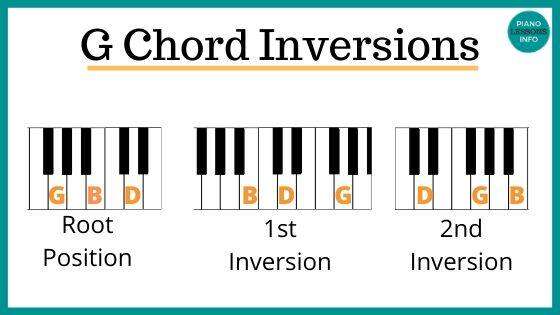
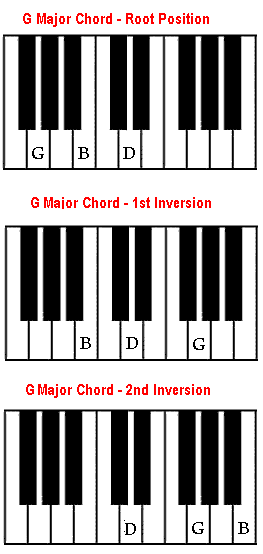
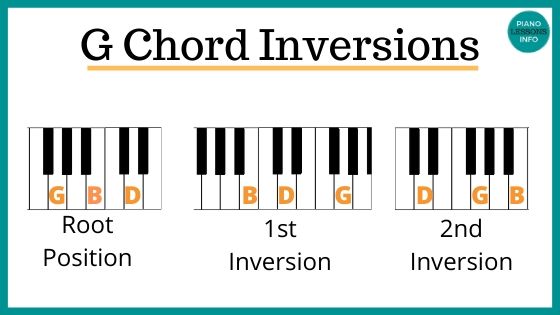
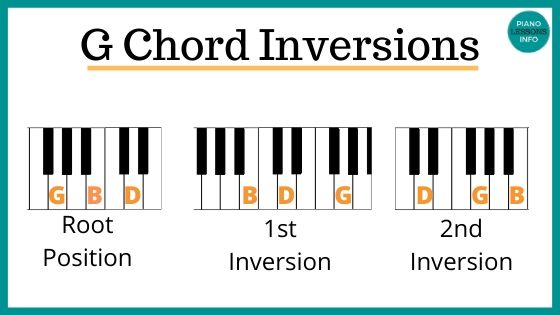
- G major triad: G, B, D. Use 1-3-5 in the right hand.
- First inversion: B, D, G. Second inversion: D, G, B.
- G7 (dominant seventh): G, B, D, F. This adds tension and leads back to C.
Practical uses
- Use the G major scale to practice finger fluidity.
- Play the chord and its inversions to build smooth chord changes.
These elements make learning how to play g on piano useful in songs and practice.
Common patterns and exercises to master G
Simple exercises
- Five-finger pattern: Play G with each finger in order and back. This builds independence.
- Arpeggio practice: Play G-B-D-G (root to octave) slowly, then increase speed.
- Scale fragments: Play 2-note and 3-note patterns inside the G scale to build muscle memory.
Chord progressions using G
- I–IV–V in G: G – C – D. Practice switching cleanly between these chords.
- I–vi–IV–V in G: G – Em – C – D. This common progression appears in many songs.
Song applications
- Learn short melodies that start on G to hear how the note functions in context.
- Play simple folk or pop lines that use the G note often.
These steps explain how to play g on piano in musical ways, not just as a single key.
Practice tips and troubleshooting
Set clear goals
- Start each session with a short goal: five clean G scales or ten arpeggios.
- Track progress in small steps. Consistency beats long sessions.
Fix common problems
- If the G sounds weak, check finger curve and wrist position.
- If you rush, slow the metronome by 10–20 BPM and aim for steady timing.
- If the G buzzes or rings oddly, check your piano action or touch pressure.
Practice structure
- Warm up with scales for five minutes.
- Spend ten minutes on the G scale and chords.
- End with a short piece or pattern that uses G.
My own tip from teaching: I once rushed practice and skipped slow repetition. The fastest improvement came when I slowed down and aimed for five perfect repetitions each day. This is how to play g on piano better and with more control.
Frequently Asked Questions of how to play g on piano
What finger should I use to play G on the right hand?
Use finger 2 or finger 3 for the G above middle C, or finger 1 in certain scale patterns. Choose the finger that keeps your hand relaxed and allows smooth movement.
How do I find G quickly on an unfamiliar keyboard?
Look for the group of three black keys. The white key immediately to the left of those is G. The pattern repeats across the keyboard.
Is G the same note across all octaves?
Yes. Each G is the same pitch class but at different pitches. Learning the G pattern helps you find any G quickly on the piano.
How long should I practice the G scale each day?
Five to fifteen minutes focused on the G scale is effective when done daily. Short, focused sessions beat long, unfocused ones.
Can beginners play chords with G right away?
Yes. Start with the basic G major triad (G-B-D) and play it slowly. Use simple inversions to make changes easier.
Conclusion
You now have clear steps to find the key, play single notes, build the G major scale, and use chords and exercises to grow. Practice slowly, use a metronome, and repeat small goals daily to make steady gains. Try the short exercises in this guide and post a question or progress update to keep learning.

Senior Music Reviewer
Alex Carter is a seasoned music reviewer with over a decade of experience in the world of sound and instruments. Passionate about helping musicians and enthusiasts make informed choices, he brings sharp insights and in-depth knowledge to every review. From classical instruments to modern gear, Alex combines technical expertise with a love for music to deliver content that resonates with readers.
As a Senior Music Reviewer and expert author on Tuneluma.com, Alex is dedicated to sharing honest evaluations, practical advice, and thoughtful commentary to guide readers in their musical journey.