Play a minor on piano by learning the minor scale, basic chords, and simple finger patterns.
I’ve taught piano and played in many bands, so I know how to play a minor on the piano feels and sounds. This guide breaks down the theory, technique, practice steps, and real tips I use so you can play minor keys with confidence and musicality. Read on and you’ll gain clear, actionable steps to play a minor on the piano today.

Understanding what "minor" means and why it matters
A minor key gives music a darker, sadder, or more thoughtful mood than major keys. To know how to play a minor on the piano, you need to learn the scale, the triads built from it, and common harmonic patterns. I’ll explain each idea in plain terms and show practical ways to use them at the piano.
Minor keys come in three common forms: natural, harmonic, and melodic. Each one changes one or two notes to create a different flavor. Mastering these will help you play a minor on the piano with both accuracy and emotion.

The three minor scales: step-by-step
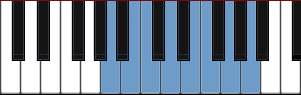
To play a minor on the piano, start with the scales. Here are the three types and how to play them.
Natural minor
- What it is: The basic minor scale that follows a fixed pattern of whole and half steps.
- How to play it: From A natural minor, play A B C D E F G A. Use standard fingerings: right hand 1-2-3-1-2-3-4-5, left hand 5-4-3-2-1-3-2-1.
Harmonic minor
- What it is: Same as natural minor but with the seventh raised by a half step.
- How to play it: In A harmonic minor, play A B C D E F G# A. This raised seventh gives a stronger pull back to the tonic.
Melodic minor
- What it is: Raises the sixth and seventh when ascending; reverts to natural minor descending.
- How to play it: In A melodic minor ascending play A B C D E F# G# A, and descend A G F E D C B A. Use smooth finger transitions for the raised notes.
Practice tip: Play each scale slowly, hands separately, then hands together. This builds coordination and helps when you apply the scales to songs. Practicing these is key to learning how to play a minor on the piano.

Building chords in a minor key
Once you can play a minor scale, make chords from the scale notes. Knowing chords is essential if you want to play a minor on the piano musically.
Triads (three-note chords)
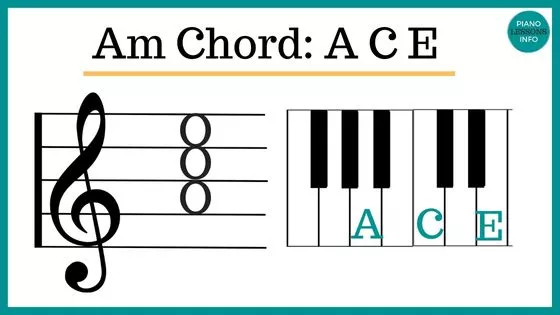
- i chord: tonic minor (A C E in A minor).
- iv chord: minor subdominant (D F A in A minor).
- v or V chord: minor v is E G B, but many songs use V (E G# B) from the harmonic minor to create stronger resolution.
Seventh chords
- i7: minor seventh adds depth (A C E G).
- ii°7: diminished seventh appears naturally in minor (B D F A in A minor forms a half-diminished quality).
- V7: dominant seventh (E G# B D) creates tension that resolves to i.
Play these chords in root position and in simple inversions. This helps you get used to shapes and makes it easier to play songs in minor keys. Learning chord function will show you how to play a minor on the piano beyond single notes.
Voicing, inversions, and smooth transitions
To make minor keys sound musical, focus on voicing and inversions. These make chords flow and create pleasing harmony.
Inversions
- Why use them: They reduce hand travel and create smoother bass lines.
- How to use them: Practice i – iv – V in root, first, and second inversions.
Voicing tips
- Keep the melody on top: Put the highest note clearly in the right hand.
- Spread chords: Use wider spacing with the left hand and tighter clusters in the right hand for clarity.
Practice moving between chord shapes slowly. I learned to make minor progressions sing by practicing transitions with a metronome and keeping the top voice steady. Using these techniques will let you play a minor on the piano with more expression.
Technique and ear training for minor feel
Technique and ear training help bring minor pieces to life. Playing well is not just about hitting the right notes.
Left-hand support
- Use the left hand for steady rhythmic support or bass lines.
- Try simple patterns: root-fifth-octave patterns to start.
Right-hand phrasing
- Shape your melody with dynamics and small rubato.
- Practice legato lines in the minor scale for a lyrical sound.
Ear training
- Sing intervals: sing the minor third, then the major third to feel the difference.
- Play chord progressions and listen for resolution from V to i.
I practiced by playing simple minor songs and then improvising over the chord progression. This trains your ear and helps you internalize how to play a minor on the piano naturally.

Simple songs and exercises to practice playing in minor
Applying theory to music makes learning stick. Here are easy ways to practice how to play a minor on the piano.
Two hands together exercise
- Right hand: play the A natural minor scale.
- Left hand: play the tonic note on each beat, then the fifth on the off-beat.
Arpeggio patterns
- Play i arpeggio: A C E A (one octave).
- Play iv arpeggio: D F A D.
Song ideas
- Start with simple folk tunes or minor-key hymns.
- Learn one full song in a minor key to practice transitions, voicing, and expression.
Keep practice sessions short and focused. I usually practice a new minor song for ten minutes a day and then expand it over the week. This steady focus is how to play a minor on the piano with real progress.
Common mistakes and how to fix them
New players often make similar errors when learning minor keys. Knowing how to play a minor on the piano means avoiding these pitfalls.
Ignoring scale differences
- Mistake: Treating all minor scales the same.
- Fix: Practice natural, harmonic, and melodic forms separately until they feel distinct.
Over-reliance on root position
- Mistake: Playing only root positions makes music sound static.
- Fix: Practice inversions and voice-leading exercises.
Neglecting dynamics and phrasing
- Mistake: Playing notes evenly.
- Fix: Mark dynamic changes and shape phrases to enhance the minor mood.
I once ignored harmonic minor and my progressions sounded weak. Raising the seventh changed everything. Small adjustments like that teach you how to play a minor on the piano with more confidence.
Practice plan: 30-day approach to learn a minor key
A short plan helps build steady progress. Use this to learn how to play a minor on the piano in one month.
Week 1
- Practice natural minor scale 10 minutes daily.
- Work on basic triads and fingerings.
Week 2
- Add harmonic and melodic minors, 10 minutes daily.
- Practice simple chord progressions and inversions.
Week 3
- Learn one minor song. Play hands together slowly.
- Add arpeggios and voicings.
Week 4
- Focus on dynamics, phrasing, and ear training.
- Record yourself and adjust based on what you hear.
Stick to short daily sessions. I found that even 20 minutes daily led to big gains in four weeks. That’s a practical way to learn how to play a minor on the piano.
Expanding beyond basics: improvisation and composition
Once you can play a minor on the piano, start exploring improvisation and writing. Minor keys offer rich emotional ground.
Improvisation tips
- Use the natural minor for modal sounds, harmonic minor for strong cadences.
- Start with a simple i – iv – V progression and try melodic variations.
Composition starters
- Create a short 8-bar phrase in a minor key.
- Use a repeating bass pattern and vary the right-hand melody.
I wrote small pieces in minor keys by looping a two-chord pattern and humming ideas. This playful approach taught me how to play a minor on the piano creatively and without pressure.
Resources and next steps
To keep growing, use targeted resources. Choose materials that reinforce how to play a minor on the piano.
Practice book suggestions
- Choose books with scales, arpeggios, and simple songs in minor keys.
- Use graded lesson books to progress step by step.
Online tools
- Metronome apps for timing.
- Backing tracks in minor keys for improvisation practice.
Take lessons if you want faster feedback. A teacher can point out small issues and speed your progress. I found lessons invaluable for correcting posture and technique when I was learning complex minor pieces.
Frequently Asked Questions of how to play a minor on the piano
What is the simplest way to start learning how to play a minor on the piano?
Start with the natural minor scale and simple triads in root position. Practice hands separately, then hands together at a slow tempo.
Which minor scale should I learn first to play a minor on the piano?
Begin with the natural minor scale, as it forms the base for harmonic and melodic minor forms. Once you know it, add the raised notes for harmonic and melodic minor.
How do I make minor chords sound full and musical?
Use inversions and voice leading to connect chords smoothly, and shape the melody with dynamics. Keep the top voice clear and use the left hand for a steady bass.
Can I improvise in a minor key if I only know basic chords?
Yes. Start over a simple i – iv – V progression and try small melodic motifs. Use the natural minor for modal sounds and the harmonic minor for stronger cadences.
How long will it take to learn how to play a minor on the piano well?
With focused practice, you can play simple minor melodies and chords in a few weeks. Mastery takes months of consistent practice and musical application.
Do I need to learn music theory to play a minor on the piano?
Basic theory helps, but you can start by ear and shapes. Theory speeds learning and helps you understand why progressions work.
Are there easy songs in minor keys for beginners?
Yes. Many folk tunes and simple melodies use minor keys and can be adapted for beginners. Start with one easy song and expand the arrangement as you improve.
Conclusion
You now have a clear roadmap for how to play a minor on the piano. Learn the three minor scales, practice chords and inversions, work on voicing, and use short daily routines. Start small, focus on one minor key at a time, and apply what you learn to real songs; your musical instincts will grow quickly. Try one new minor song this week, record your progress, and share your result or questions below — I’d love to hear how you improve.

Leave a Reply