Play the riff with your right hand while the left anchors simple root notes and steady rhythm.
I teach piano and have arranged pop and rock songs for students for over a decade. This guide walks you through how to play 7 nation army on piano from the first notes to confident performance. I’ll share clear steps, fingerings, practice plans, and tips I learned while teaching this song to beginners and gigging pianists.

Why the song translates so well to piano
The main riff of how to play 7 nation army on piano is short, bold, and easy to remember. That makes it perfect for piano. The riff sits in a narrow range and repeats. This gives you space to add rhythm or harmony without losing the hook.
The song’s groove is flexible. You can make it sound like the original or give it a piano twist. My students often learn the riff in one lesson and play a full arrangement a week later. This shows how approachable the piece is for players at many levels.

What you need to get started
Keep gear and materials simple. You do not need an advanced piano. A basic keyboard with weighted keys is fine.
- A piano or keyboard with at least 61 keys.
- A simple sheet or lead sheet showing the riff and chords.
- A metronome or phone metronome app.
- Patience and 10–15 minutes of focused practice per day.
Learning how to play 7 nation army on piano is about feel more than gear. I often tell students: start small, then add flair.

The main riff — notes, fingering, and reading it
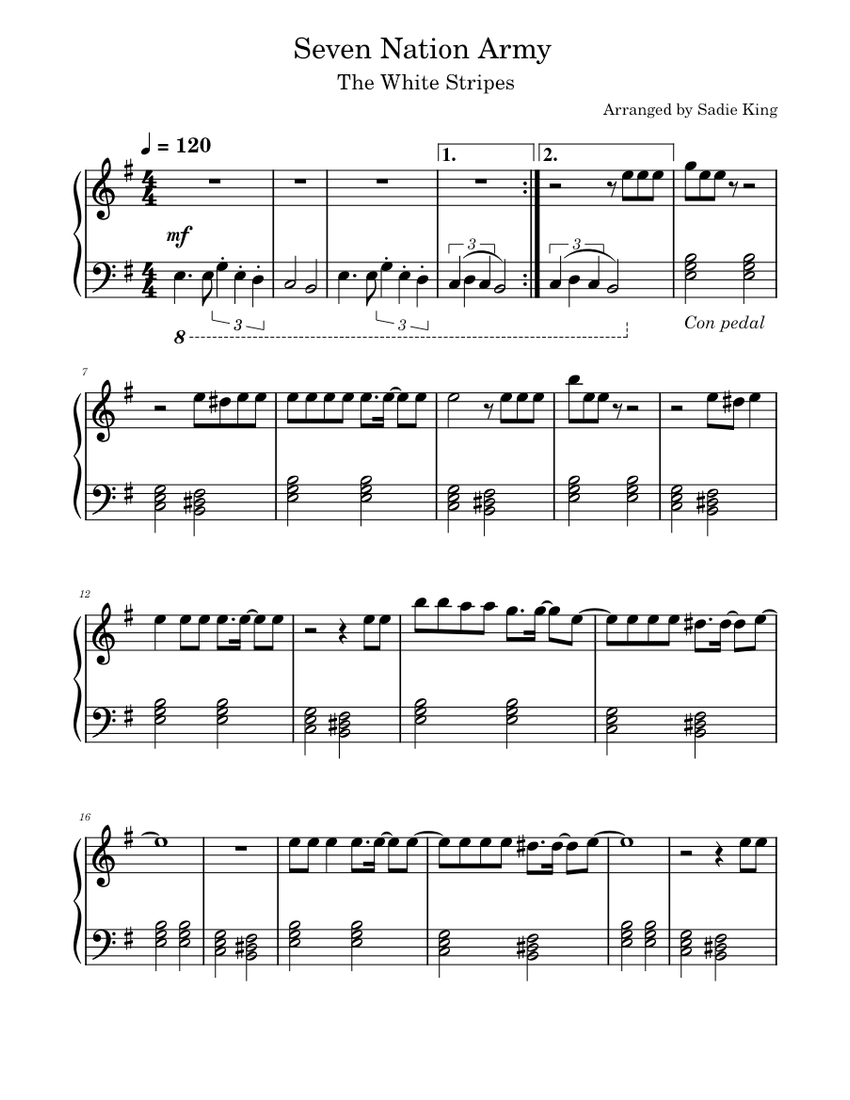
The riff is the soul of how to play 7 nation army on piano. Learn it slowly first.
- Notes for the riff (in concert pitch): E E G E D C B
- Fingering suggestion for right hand: 1 1 3 1 2 1 3
- Play the first E twice, then jump to G, then back to E, then step down D C B.
Steps to learn the riff
- Play only the note sequence with your right hand at quarter-note tempo.
- Use the recommended fingering. It keeps your hand stable.
- Repeat until the pattern feels natural before speeding up.
Play the riff cleanly before adding left hand or rhythm. When you practice, clap the rhythm first if it helps.
Left hand, rhythm, and basic accompaniment
The left hand can be simple and strong. Use root notes or an octave for weight.
- Basic left-hand pattern: play E (root) on beats 1 and 3.
- For more drive: play E octave on beat 1, low E on beat 3.
- Add a simple chord stab on beat 4 for variety.
Tips on rhythm and groove
- Use a metronome to lock the pulse. Start slow.
- Keep the left hand steady. It holds the groove for the riff.
- Try alternating full chords and single bass notes for dynamics.
I often tell students to imagine the left hand as the drummer. It keeps everything in time.
 together — step-by-step practice plan”
style=”max-width: 100%; height: auto; border: 2px solid black; border-radius: 10px; display: block; margin: 0 auto;”
loading=”lazy”
/>
Putting it together — step-by-step practice plan
A clear plan helps you learn how to play 7 nation army on piano fast. Follow structured steps.
- Step 1: Right-hand riff only. Play 5 minutes slow.
- Step 2: Left-hand root on beats. Add 5 minutes.
- Step 3: Hands together, very slow, stair-step tempo.
- Step 4: Add dynamics and small fills. Play entire riff and loop.
- Step 5: Practice with a metronome and slowly raise tempo to performance speed.
Practice tips I use with students
- Work in short bursts of 10 minutes.
- Record yourself to hear small tempo slips.
- Isolate trouble spots for targeted practice.
This routine helped my beginner students go from zero to a confident loop in less than a week.

Variations and arrangement ideas
Once you master the main idea of how to play 7 nation army on piano, try variations. They make your version interesting.
- Simple pop version: riff in right hand, chords in left hand.
- Ballad version: play the riff an octave higher with slow arpeggiated chords.
- Full arrangement: add a bridge using the song’s chords and a countermelody in the left hand.
Arrangement tips
- Keep the riff recognizable. That is the hook.
- Change dynamics across repeats. Build tension and release.
- Use pedal sparingly to keep clarity.
These ideas let you adapt the song for practice, performance, or recording.

Common mistakes and how to fix them
Most problems are small and easy to solve. Here are frequent issues and quick fixes.
- Playing too fast too soon: slow the metronome and use shorter practice chunks.
- Wrong fingerings: write finger numbers on your sheet and follow them.
- Left hand losing pulse: practice left hand alone with a metronome.
- Muffled sound from over-pedaling: use less pedal and lift cleanly on chord changes.
I once taught a student who rushed the return to the E. We used a metronome click on every beat for two sessions, and the accuracy improved dramatically.

Frequently Asked Questions of how to play 7 nation army on piano
How long does it take to learn the riff?
Most players can learn the riff in one session of focused practice. Mastery with both hands and rhythm usually takes a few days to a week.
What key is 7 Nation Army in for piano?
The main riff is centered around E in many arrangements. You can transpose it to fit vocal range or comfort.
Should I use the sustain pedal when playing this song?
Use the sustain pedal sparingly. Light pedal helps when playing ballad versions, but crisp playing suits the iconic riff best.
Can beginners play a full arrangement?
Yes. Beginners can play a simple riff plus root notes quickly. More complex arrangements require intermediate skills and practice.
How do I make my version sound unique?
Change the octave, add chord stabs, use syncopated left-hand patterns, or write a short bridge to personalize the song.
Conclusion
Learning how to play 7 nation army on piano is fast, fun, and highly rewarding. Start with the clear riff, add a steady left hand, and build small variations. Practice with a plan, listen to your recordings, and focus on timing over speed. Try the steps here, play daily, and share your progress or questions in the comments — I’d love to hear how your arrangement sounds.

Leave a Reply