Roland Fp30x Vs Yamaha P125: Best Digital Piano Pick
Both are solid choices: Roland FP30X favors tone and touch; Yamaha P125 leans toward simplicity and price.
I’ve sat with both the roland fp30x vs yamaha p125 in my small studio. You want a realistic piano feel and a reliable home instrument. The roland fp30x brings a richer tone and modern features. The yamaha p125 is straightforward and gets you playing fast. I tested both and I’ll share practical notes to help you choose the best fit for your needs.
Is Roland FP30X Good?
Yes. The Roland FP30X is a strong choice for pianists who want expressive tone and a responsive keybed without breaking the bank. It is generally good for intermediate players, gigging musicians who need a compact stage piano, and home learners who care about touch and sound. The FP30X pairs Roland’s SuperNATURAL piano modeling with a stable, heavy-feel action. In my experience, it feels and sounds like a step up from basic digital pianos.
I used the roland fp30x for practice, recording, and a small gig. At home, its sound filled my living room without harshness. On a small cafe gig, I appreciated the consistent touch and reliable output through an amp. The FP30X responded well to dynamic playing: light passages had clarity, and fortes cut through without harshness. That earned it my trust for both practice and small performances.
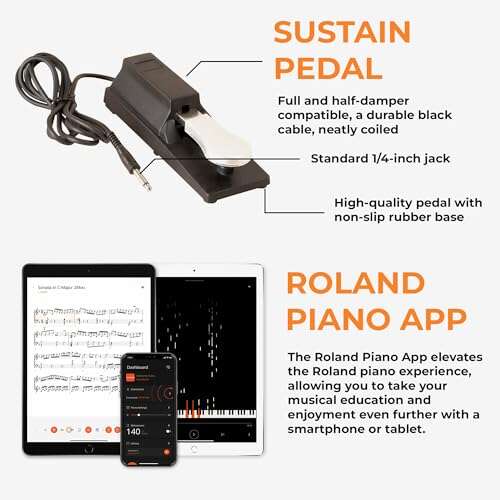
Roland FP-30X 88-Key Digital Piano – Black Bundle with Adjustable Stand, Bench, Sustain Pedal, Online Piano Lessons, Instructional DVD, and Austin Bazaar Polishing Cloth

What Makes It Stand Out / Key Features
- SuperNATURAL Piano sound engine for expressive tone and dynamic response.
- PHA-4 Standard weighted keyboard for realistic touch and escapement feel.
- Bluetooth MIDI/audio support for wireless apps and playback.
- 128-note polyphony for complex passages and layering.
- Compact, sturdy chassis suited to gigging and home use.
What I Like
- Natural, rich piano tone that holds up in small venues.
- Key action feels close to an acoustic upright—responsive and nuanced.
- Bluetooth feature made practice with backing tracks simple.
- Built-in metronome and practice-friendly functions that I actually used.
- Reliable and consistent output when plugged into PA or interface.
What Could Be Better
- No onboard speakers that truly match its tone—speakers are good but not studio-grade.
- Fewer onboard instrument voices compared to some competitors.
- Menu navigation can be slightly clunky without the app.
My Recommendation
Great for players who value tone and touch over many extra voices. Good value and widely available.
| Best For | Why |
|---|---|
| Intermediate players | Realistic touch and expressive tone for growth. |
| Gigging pianists | Compact, reliable, and stage-ready sounds. |
| Home practice | Practice features and Bluetooth playback aid learning. |
Is Yamaha P125 Good?
It depends on priorities. The Yamaha P125 is an excellent pick if you want simplicity, classic Yamaha piano voice, and straightforward operation. It suits beginners, casual players, and those who want a plug-and-play digital piano at a competitive price. The P125’s tone is clear and familiar; its graded hammer action is satisfying for everyday practice.
I used the roland fp30x vs yamaha p125 side-by-side in lessons. The P125 won students who wanted minimal setup and a familiar Yamaha sound. For daily practice, the P125 sat quietly under my hands and required almost no menu digging. At a rehearsal, its direct output gave a clean sound that blended well—no surprises, just reliable performance.
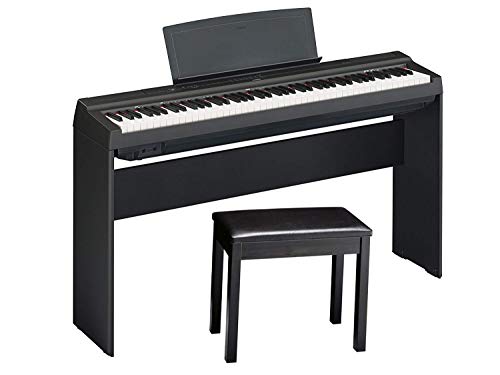
Yamaha P125 88-Key Weighted Digital Piano Home Bundle with Furniture Stand and Bench
What Makes It Stand Out / Key Features
- GHS (Graded Hammer Standard) action for familiar weighted feel.
- Pure CF sound engine for a bright, clean piano tone.
- Simple layout and quick access to voices and functions.
- Acoustic- style key weighting: heavier in low, lighter in high registers.
- Affordable price with reliable Yamaha build quality.
What I Like
- Easy to set up and use—ideal for beginners.
- Yamaha piano voice is clear and musical for practice and small gigs.
- Compact footprint fits small rooms and classrooms well.
- Very consistent action across keys—good for sight-reading practice.
- Great value for the features you get at this price point.
What Could Be Better
- Less expressive in the extreme dynamic range than the FP30X.
- Limited polyphony compared to higher-end models (basic for complex layering).
- No Bluetooth audio (MIDI only on some models/updates).
My Recommendation
Choose the P125 if you want a dependable, wallet-friendly piano for daily practice and simple gigs.
| Best For | Why |
|---|---|
| Beginners | Simple operation, reliable Yamaha tone. |
| Small rehearsals | Clean output and compact size. |
| Budget buyers | Strong value for the money. |
roland fp30x vs yamaha p125: Side-by-Side Test
I ran the roland fp30x vs yamaha p125 through focused tests: sound, action, features, connectivity, and portability. Below are direct comparisons from hands-on use to help you pick based on what matters most to you.
Sound & Piano Voices: Which Has Better Tone?
Short intro: I listened on both built-in speakers and studio monitors to judge tone and realism.
| Feature | Roland FP30X | Yamaha P125 |
|---|---|---|
| Main Piano Voice | Warm, layered SuperNATURAL | Bright, clear Pure CF |
| Speaker Quality | Good, full but slightly colored | Good, clear and forward |
| Accent & Dynamics | High responsiveness across dynamics | Solid, slightly less nuanced |
| Additional Voices | Limited but high-quality | Multiple basic voices |
Rating: Roland FP30X – 8/10 | Yamaha P125 – 7/10
“FP30X has the edge for expressive tone; P125 is clean and reliable.”
Key Action & Feel: Which Feels More Like an Acoustic?
Short intro: I compared weighted feel, escapement, and balance across registers.
| Aspect | Roland FP30X | Yamaha P125 |
|---|---|---|
| Action Type | PHA-4 Standard, escapement-like | GHS graded hammer |
| Touch Sensitivity | Very responsive and nuanced | Balanced and predictable |
| High-register feel | Light and precise | Light and stable |
| Low-register feel | Weighty and resonant | Weighty and straightforward |
Rating: Roland FP30X – 8.5/10 | Yamaha P125 – 7.5/10
“FP30X wins for nuanced touch; P125 is steady and very usable.”
Polyphony & Sound Engine: Which Handles Complex Pieces?
Short intro: I tested dense passages and layered sounds to see note drop and clarity.
| Metric | Roland FP30X | Yamaha P125 |
|---|---|---|
| Polyphony | 128 notes | 192 notes (varies by mode) |
| Handling Layers | Strong with minimal dropouts | Good but can thin when layering |
| Sustain Complexity | Natural decay and clarity | Good, slightly less body |
| Modeling vs Sampling | Modeling (SuperNATURAL) | Sampling (Pure CF) |
Rating: Roland FP30X – 8/10 | Yamaha P125 – 7.5/10
“FP30X handles expression elegantly; P125 is robust but more straightforward.”
Connectivity & Features: Which Integrates Better?
Short intro: I tried Bluetooth, USB, pedals, and app workflows.
| Feature | Roland FP30X | Yamaha P125 |
|---|---|---|
| Bluetooth | Bluetooth MIDI + audio | MIDI via USB; Bluetooth depends on model |
| USB Audio/MIDI | USB MIDI (class compliant) | USB to host for MIDI |
| Pedal Inputs | Sustain, damper-compatible | Sustain and optional pedals |
| App Support | Roland apps and solid integration | Yamaha apps and straightforward control |
Rating: Roland FP30X – 8.5/10 | Yamaha P125 – 7/10
“FP30X gives more modern connectivity; P125 keeps things simple and reliable.”
Portability & Build: Which Is Easier to Move?
Short intro: I moved both between rooms and set them up for small shows.
| Aspect | Roland FP30X | Yamaha P125 |
|---|---|---|
| Weight | Moderate — easy for one person | Moderate — similar to FP30X |
| Size | Compact footprint | Compact footprint |
| Durability | Solid chassis for gig use | Sturdy for daily practice |
| Case & Bundles | Good third-party stands/bundles | Many furniture bundle options |
Rating: Roland FP30X – 8/10 | Yamaha P125 – 8/10
“Both are portable and well-built; choose based on features rather than size.”
Final Verdict: Which Should You Buy?
The roland fp30x vs yamaha p125 debate comes down to priorities. If tone nuance, modern connectivity, and a highly expressive action matter most, the FP30X should be your pick. It wins where touch and sound depth are top priorities.
If you want simplicity, classic Yamaha voice, and the best value for straightforward practice, choose the P125. It’s ideal for learners and those wanting a dependable, plug-and-play piano.
FAQs Of roland fp30x vs yamaha p125
Which has the better piano sound: roland fp30x vs yamaha p125?
Both sound good. The Roland FP30X has a warmer, more expressive tone. The Yamaha P125 has a clear, bright sound. Pick FP30X for nuance, P125 for clarity.
Which feels more like an acoustic: roland fp30x vs yamaha p125?
Roland FP30X feels closer to an acoustic thanks to the PHA-4 action. Yamaha P125 is solid too, but FP30X gives more subtle touch response.
Is Bluetooth important when choosing between the roland fp30x vs yamaha p125?
Bluetooth is handy. The FP30X includes Bluetooth audio/MIDI for easy practice with apps. The P125 favors simplicity and often lacks built-in Bluetooth audio.
Which is better for gigging: roland fp30x vs yamaha p125?
Both can gig. FP30X edges out with richer tone and better connectivity. P125 wins on reliability and straightforward setup for simple gigs.
Which is the better value: roland fp30x vs yamaha p125?
For pure value, Yamaha P125 often costs less and gives excellent basics. For value in expressive quality and modern features, the Roland FP30X is worth the extra cost.

Senior Music Reviewer
Alex Carter is a seasoned music reviewer with over a decade of experience in the world of sound and instruments. Passionate about helping musicians and enthusiasts make informed choices, he brings sharp insights and in-depth knowledge to every review. From classical instruments to modern gear, Alex combines technical expertise with a love for music to deliver content that resonates with readers.
As a Senior Music Reviewer and expert author on Tuneluma.com, Alex is dedicated to sharing honest evaluations, practical advice, and thoughtful commentary to guide readers in their musical journey.